Showing posts with label GLV. Show all posts

Wednesday, July 1, 2026

🍁 🍁 Honouring Canada Day 🍁 🍁


🍁 🍁 🍁 🍁 🍁


🍁 🍁 🍁 🍁 🍁


🍁 🍁 🍁 🍁 🍁


Two pictures which I took on a very soggy Canada Day in Ottawa in 2017, for the 150th anniversary of Canadian Confederation.


Bonne fΓͺte du Canada!

🍁 🍁🍁🍁  

Happy Canada Day!


Today, July 1st, is Canada Day.

This was an important date in Canadian history. Mostly because this was when the Confederation of Canada was created in 1867, but it was also important for some other reasons as well. American privateers attacked Lunenburg, in Nova Scotia. Nine years before Canada became a Union, it minted it's own coins (i, 5, 10, and 20 cent coins). The decimal currency system was incorporated in Canada, and Canada and the United States ended a fishery agreement. The first international telephone conversation took place on this day, with a call between Calais, Maine, and St Stephen, New Brunswick. Prince Edward Island officially became a province of Canada. Wilfred Laurier became the first French-speaking Prime Minister of Canada. Less happy history - it was on this date in 1933 that Canada suspended all Chinese immigration into the country. Eventually on this date, O Canada! became the official national anthem for Canada.

But most importantly, of course, it was on this day in 1867 that the Dominion of Canada came into existence. I have spent Canada Day inside of Canada a few times, most recently in 2017, for the 150th anniversary of Confederation. Usually, in Quebec City, where they traditionally have free outdoor concerts and other celebratory events during the time of the end of June until early July. That is because June 24th is St. Jean Baptiiste Day in Quebec province, and then Canada Day a week later. So, it's a good time to take a trip there. Plus, there's a good chance that you can catch a good band or two. I think it was 2005 that I saw Tea Party up there (no, not the ridiculous American pseudo-political movement, but rather the pretty cool band).

Now, having lived in the United States for most of my life - and unfortunately, never having lived in Canada - it seems pretty clear to me that ignorance of Canada is strong. I have known many Americans who really had no idea of what Canada was like. Some  - and I am talking about grown adults here - believed that it must be cold and possibly snowy all year long. Some - quite a few, actually - were under the impression that French was the dominant language, including one friend who I actually went to Quebec province with back in our college days. He actually was disappointed and claimed to be pissed off when I told him that, in fact, Quebec was the only province of the ten in Canada where French was the dominant language. Another, when I asked him what the "other" language (other than French) officially spoken in Canada, answered uncertainly that perhaps it was German. Apparently, he did not imagine that they spoke English there. And no, sadly, I am neither kidding nor exaggerating about any of this. These were actual things that people said of Canada, and that's arguably not even the worse thing. Indeed, I knew a guy - a young man who used to be a student at the school I worked at, but who had become a fully grown adult by this point - who was trying to move to Toronto and was stunned by how much paperwork was involved. He said that he could not remember anywhere near the same level of paperwork when he moved from New Jersey to New York. I told him (apparently informing him) that Toronto was in Canada, and thus, an entirely different country. He deleted the post shortly after that, perhaps out of embarrassment, although I will not speculate any farther.

Nor were they alone. I knew a guy in France who simply assumed that Quebec was France, for all intents and purposes. Tell that to the people of Quebec, and I think he might have been surprised by what their reaction to that might be. That is not to say there are not similarities and cultural ties, because obviously, there are. But the people inside of Quebec most certainly do not feel themselves de facto Frenchman and, in certain regards, live very different lives. 

The point is, knowledge about Canada outside of Canada itself seems to be extremely limited. Sadly, that seems particularly true in the United States, a fact which, as an American, embarrassed the hell out of me. I always loved taking trips to Canada ever since my first trip there in 1983. I have been there a number of times, but you would be amazed how many people seem to think that multiple trips to Canada would be pointless, as if visiting, say, Quebec City is the same exact thing as visiting Toronto or Vancouver. Or that visiting the Maritime provinces is the same thing as visiting the Canadian Rockies. Or that Canada is not actually as big as it is - it has long been the second biggest country in terms of land mass in the world - and does not have the vast diversity of various landscapes and the accompanying cultural differences that it is known for. Even the French-speaking community is not all one and the same. While Quebec province is the only province where French is spoken by a majority (and a wide majority, at that), it is not the only province where French is spoken. In fact, there are communities of French-speakers in literally every Canadian province, and nearly a third of the population of New Brunswick speak French. There are also over 100,000 people in Ontario who speak French as their first language, including just under 20 percent of the people of Ottawa, Canada's capital city. And within the English-speaking provinces, I might argue that there are more differences - both geographically and culturally - between those people in the rural province of Newfoundland and Labrador, and those in Ontario's capital of Toronto, which happens to also be Canada's largest city, with massive urban sprawl. And all of those people likely live very different lives than the people who live in Victoria, a city which looks and feels quite English. Indeed, it has sometimes been regarded as English Canada's answer to Quebec City for French Canadians. In fact, despite having visited London with my son last year, the only time that I actually ever had "tea time" at a restaurant remains in Victoria, British Columbia. 

Long have I believed that Americans really need to begin to pay attention to the world outside of their own sacred borders. And they could do worse than begin by learning more about our neighbors - sorry, our neighbours - to the north. And so, my recent blog entries on Canada for this week in between St Jean Baptiste (celebrated exclusively in Quebec province) and Canada Day (which is celebrated throughout Canada, and honors the day when Confederation was achieved back in 1867. 


Here are some pictures from our visit to Charlottetown, and particularly the Province House, which was billed the "Birthplace of Confederation."


Finally, I wrote an article on Canada Day for the Guardian Liberty Voice which was published on this date in 2015. Fairly recently, I found out that this was a widely viewed article, with thousands and thousands of views, most likely making it the most widely read piece that I have written to date. Hopefully, you take a look. Here's the link:


Canada Day Has a Long and Divided History:

https://guardianlv.com/2015/07/canada-day-has-a-long-and-divided-history/ 

Saturday, April 25, 2026

🌎 🌲 Earth Day Week: Some Obscure History Regarding Climate Change & Environmentalism 🌲 🌎


The old button from the Environmental Club days which I just happened to find on Earth Day! It is a little beat up (particularly the ends of the ribbon), but no worse for the wear, I think. And it is one of the few items that I have left from those days, so it carries a lot of great memories for me! Nothing Changes Until You Do!


Here is a picture of a very similar logo, with the same message, that was on the t-shirt that I purchased from the BCC Environmental Club and, if memory serves me correctly, may even have helped to make. There were a few projects like that which club members, myself included, were regularly involved with. It has been so long, however, that I no longer recall specifically if I actually helped to make these or not, although I do believe so, since I remember seeing the process of the t-shirts being dyed. In any case, I loved this t-shirt, and have kept it ever since, even if I do not regularly wear it. Since it was part of my experience with the BCC Environmental Club days, as well as more generally having an environmental theme, it seemed appropriate to share it here. 


"Earth provides enough to satisfy every man's needs, but not every man's greed."

~Mahatma Gandhi


"Change is the law of life. And those who look only to the past or present are certain to miss the future."
  
~John F. Kennedy  


"The earth does not belong to man. Man belongs to the earth. All things are connected like the blood that unites one family. Man did not weave the web of life. He is merely a strand in it. Whatever he does to the web he does to himself."

- Native American Philosophy (most often attributed to Chief Seattle)


“Humankind has not woven the web of life. We are but one thread within it. Whatever we do to the web, we do to ourselves. All things are bound together. All things connect.”

~ Chief Si’ahl (Seattle) 


“Now polluters are looked upon as ordinary Joes just doing their jobs. In the future, they will be looked upon as swine”  

~ Kurt Vonnegut


Yes, it is Earth Day Week, and I already wrote an article on the history of Earth Day on the Guardian Liberty Voice.

If you have not yet seen it, please take a look at my article, which was published in April of 2015, about the history of Earth Day, which you can find on the Guardian Liberty Voice. Please click on the link below:

Earth Day Has a Fascinating History by Charles Bordeau on April 18, 2015:


However, environmentalism did not begin with Senator Nelson, although I think that his Earth Day creation was something that this global society of ours needed desperately, and has been largely a positive step towards restoring some kind of a balance.

In truth, the history of environmentalism, if we define it as a conscious effort to have a sustainable relationship with Mother Earth, far predates our modern Earth Day and the numerous environmentalist movements, or Senator Nelson, or James Hansen recognizing the trend of global warming, or Rachel Carson, or even Henry David Thoreau, however good and noble the works and words of these people might be.

It goes back to Native Americans, who tried to warn our modern society of the dangers of not taking our responsibilities towards Earth seriously. We did not listen to them, and now we are paying the price for our arrogance and foolish presumptions of the time.

Yet, it is interesting to note, also, that some apparently even forecast global warming itself. There is one man, with one speech in particular, who suggested as much, and this was something that I was not aware of until just recently.

This was a fascinating thing, although a bit depressing on some levels, and not least of all because of the use of such terms as "savages" in the speech.

Still, to have apparently forecast global warming well over a century before it became an accepted scientific theory?

Pretty fascinating stuff!

Take a look, and click on the link below for more information on it:

"Man cannot at his pleasure command the rain and the sunshine, the wind and frost and snow, yet it is certain that climate itself has in many instances been gradually changed and ameliorated or deteriorated by human action. The draining of swamps and the clearing of forests perceptibly effect the evaporation from the earth, and of course the mean quantity of moisture suspended in the air. The same causes modify the electrical condition of the atmosphere and the power of the surface to reflect, absorb and radiate the rays of the sun, and consequently influence the distribution of light and heat, and the force and direction of the winds. Within narrow limits too, domestic fires and artificial structures create and diffuse increased warmth, to an extent that may effect vegetation. The mean temperature of London is a degree or two higher than that of the surrounding country, and Pallas believed, that the climate of even so thinly a peopled country as Russia was sensibly modified by similar causes."
~George Perkins Marsh, 1847


The 1847 lecture that predicted human-induced climate change  by Leo Hickman  Monday 20 June 2011

http://www.theguardian.com/environment/blog/2011/jun/20/george-perkins-marsh-climate-speech


A 50th anniversary few remember: LBJ's warning on carbon dioxide By Marianne Lavelle The Daily Climate, February 2, 2015:

http://www.dailyclimate.org/tdc-newsroom/2015/02/president-johnson-carbon-climate-warni

Tuesday, March 17, 2026

St. Patrick’s Day History

Hey guys!

I wrote an article in 2015. This was in the tradition that I have been trying to keep with writing about the history of holidays - although I am still kicking myself for missing Valentine's Day, which had an interesting history that I would have loved to write an article for in the Guardian Liberty Voice.

Still, in any case, at least I was able to get this one done, and now, it is published. Truth be told, I liked the old picture that I had a lot better than the one that was actually accompanying this article.

So, please take a look at the finalized, now published article about the history of St. Patrick's Day, and learn some interesting facts that might dispel some popular myths and misconceptions about this particular holiday. Here's the link below:


St. Patrick’s Day History

Friday, December 26, 2025

Boxing Day

My family took a nice holiday trip to Montreal way back in 1988, for the week between Christmas and New Year's Day. It was a trip that allowed my family, which has French roots, to really fall in love with Canada, and particularly with Quebec province.

But there was one thing that I remember seemed a mystery to me. The day after Christmas, there was this strange holiday that I had never really heard of. It was called "Boxing Day".

It sounded so strange, so....foreign, to me. It felt like there was a measure of exoticism in the holiday.

What was this "Boxing Day", anyway? Did it really have something to do with the sport of boxing, which was the first image that came to my mind? Did it perhaps have more historical roots, perhaps some sort of association with the Boxing Rebellion in China?

I really did not know. And, truth be told, it seems like it is a mystery to many others around the world, including many Americans.

So, for this Boxing Day, I thought it would be appropriate to do some research on it, and explore it further, in order to slake my own thirst of knowledge on the subject. This is some research that I have been meaning to do for some time, and actually did a long while ago. But, with the renewed activism on "The Charbor Chronicles", it also seemed an appropriate subject for this day in particular.

Boxing Day is a holiday traditionally celebrated in Great Britain and the British Commonwealth nations, including Canada and Australia. The idea behind it is that those who are more fortunate and better off generally are to give gifts to those who are less well off. It seems more or less like an extension of the most idealistic notions of gift giving during the Christmas season, along the lines of Charles Dickens in his famous "A Christmas Story".

Boxing Day is not a national holiday in the United States, although it is recognized in some measure in northern parts of the nation, particularly areas neighboring or near Canada.

So, why is it called "Boxing Day"? That much remains unclear. There are theories, of course. The one that seems to make the most sense is the close association to "Christmas boxes" as presents, and this term would then be an extension of that.

Now, Boxing Day is known as a shopping day, not unlike "Black Friday" in the United States. It may seem odd to you, as it kind of does to me, that this shopping holiday falls on literally the day after Christmas, when most people's Christmas shopping is done, and many people are thinking of saving up. But, there you have it. It almost makes me wonder why Boxing Day has not become an American holiday yet, because any holiday associated with shopping seems capable of taking off in the most consumer obsessed culture on the planet.

Also, not unlike Thanksgiving in the United States, Boxing Day is apparently a huge day for sports in participating countries, sure to get an unusually large audience because of the holiday.

You know, as an American, I kind of wish that we did celebrate Boxing Day. We could use more days where we focus on the needs of others, particularly those less fortunate. It's not a bad idea. Also, it feels to me to truly be symbolic of the spirit of the season.

For now, however, Boxing Day remains relegated to Commonwealth nations.

Please take a look at my published article on the Guardian Liberty Voice that explore the history of Boxing Day in greater detail:


Boxing Day History and Traditions

http://guardianlv.com/2014/12/boxing-day-history-and-traditions/


Here is the video attached with my GLV article, which you can view here as well:


Here are some websites that helped me in writing this particular blog entry:


Wikiepedia page on Boxing Day:

http://en.wikipedia.org/wiki/Boxing_Day


"What is Boxing Day?" on About.com under British & Irish Food:

http://britishfood.about.com/od/christmas/p/boxingday.htm


Here is a fascinating piece on the history of Boxing Day by Time magazine: "A Brief History Of Boxing Day" by Claire Suddath of Time magazine,  Friday, Dec. 25, 2009:

http://content.time.com/time/world/article/0,8599,1868711,00.html


"All you need to know about Boxing day matches – History and memories" bySakshi of Sportskeeda – Tue 24 Dec, 2013:

Thursday, December 25, 2025

Christmas History Predates Christianity


So, I wrote a blog years ago, where I explored a little bit about the origins of the Christmas holiday, just out of curiosity (reprinted below).

However, I was not feeling fully satisfied with it, and so this year, with the pressure of having editors checking my work, as well as certain criteria that need to be met, I decided to do a more extensive article on the history of Christmas, including the pre-Christian origins of the holiday.

It was pretty fascinating, and I can honestly say that I learned quite a bit while doing the research. It is a more informative piece than my Christmas article from last year. If you are interested, I urge you to go ahead and click on the link below so that you can read the article, which also has a video attached. There is some fascinating material there.

Some of the things I did not know, and even though I tried to make the history of Christmas complete, there are some things that I had to leave out, because the article was already growing too long for that site. I needed to rein it in a bit, and so it did not include all of the information that I encountered.


That said, I will now try to add some of the information that was missing, which I did not include in the article, since this is my own blog page.


"The tendency to claim God as an ally for our partisan value and ends is the source of all religious fanaticism."
~Reinhold Niebuhr  


If you are reading this blog page, I have to imagine that you are an adult. And since we are all adults, I wanted to discuss something that has been on my mind lately - specifically because it is Christmas time.

Now, don't get me wrong, I love Christmas. It really can bring out the best in all of us, the best in humanity, because of the emphasis on giving. If human beings are not at their best then, then when are we at our best, anyway?

The Significance of December 25

The oldest is Horus (circa 3000BC). He was also born on December 25th, and born from a virgin, with a star in the east. There were three kings present for his birth. He was teaching people at 12 years old, and leading a ministry at 30, with exactly 12 disciples to spread his word. He walked on water and healed the sick, was crucified, and came back to life three days later.

There was Attis (circa 1200BC), who was also born of a virgin on December 25th. He was crucified, and raised from the dead after three days.

We also have the Persian God Mithra (circa 1200BC), who was honored by a popular cult known as the Mystery Cult, which honored the virgin birth of Mithras on December 25th. Placed on a manger as a baby and attended by shepperds. he had 12 disciples and performed miracles. His message was to personally sacrifice for the greater good of the world, and ascended to Heaven. He was known as the way, the truth, and the light. He also was crucified and resurrected after three days.

There was Krishna (circa 900 BC), who was also born of a virgin when there was a star in the eastern sky. Like Jesus, Krishna also performed miracles and was known as the "son of God." He also happened to be the son of a carpenter, and was resurrected after his death. 

Finally, we have the Greek god Dionysius, the god of wine (circa 500BC). he also was born of a human mother impregnated by Zeus on December 25th (he was later reborn by Zeus, who used a piece of his own leg), and performed miracles, including turning water into wine. Dionysius taught and traveled widely in his day. He was known as the "Holy Child" and was also resurrected after his death.

So, we can see that all of these mythical figures had their birthday on December 25th, which was picked (yes, picked, because there is no actual concrete proof) as the day to recognize and honor the birthday of Jesus. It was both a way to blend the long established traditions of worship on a sacred day for pagan faiths, while simultaneously replacing it, which is to say accelerating the process for many in forgetting it.

December 25th is also significant for another reason, as well. The ancient Romans honored this day as the Winter Solstice to honor the "Unconquered Sun". Indeed, it is right around the time when days begin to get longer, even though the winter season has essentially just begun. So, Pagans recognized this as a time to worship the sun, understandably, even with months of often harsh winter yet to come. One can see the positive and hopeful motives behind this. Generally, it is roughly three or so days after the winter solstice, and this was indeed recognized by many so-called pagans before Christianity, so the date was already significant. It would be easy enough, and very convenient, for Christianity to pick up on this significance for one of the most important dates in the Christian calendar.

There is no mention of the birth date in much of early Christian writing. Celebrating the birth of Jesus was hardly a unanimous, undisputed thing when it was first instituted, and Origen of Alexandria (circa 165-264) even mocked the practice of recognizing this particular date, and considered them remnants of "pagan" traditions.

Overall, celebrations during this time of the year in recognition of the winter solstice are actually quite widespread. Many of them I get into in the article for the Guardian Liberty Voice, and again, I do hope you will take a look at it. But in the interest of space and time (I had to make sure it was actually published by Christmas day itself), not everything was mentioned. One thing that I left out, for example, was a tradition recognizing the sun god for the winter solstice, although the Spanish banned this tradition when they tried to convert the Incas to Catholicism. Yet, in the 1950's, a small group of Quecia Indians from Cusco, Peru, resurrected the tradition, and it has grown into a major festival in the present day.

There are the St. Thomas' Day celebrations honoring St. Thomas the Apostle. That falls on December 21,the shortest day of the year. Mayan Indians in Mexico and Central America honored the sun god in what was known as polo voladore, or “flying pole dance”.

For the Kalasha or Kalash Kafir people of northwestern Pakistan, there is something called Chaomos, which lasts no less than seven days, and always includes the winter solstice. There are baths that represent cleansing, as well as a torchlight procession, singing, dancing, and feasts complete with bonfires.

There are plenty of others, as well. The yule was a Scandinavian god of fertility, and the tradition of Yuletide carols and greetings seems to have stemmed from that. Decorating with wreaths was a Wiccan tradition, adopted by practitioners of Christianity for Christmas. Druids began the tradition of putting up a mistletoe with hopes of getting a kiss as reward. The tradition of putting in a decorative tree into your home seems to have stemmed from the older tradition of putting a Saturnalia tree to honor Saturn. The fairy tale of some jolly stranger entering your home and giving gifts for the holidays existed in other traditions, with Thor, Odin, and St. Nicholas all establishing that before the more recent myth of Santa Claus. Sleipnir, Odin's eight-legged horse, who predated the eight reindeer that brought Santa across the globe to slide down chimneys and give those wonderful gifts to the children of families. Mithras celebrated the sun's rebirth on December 25th. Finally, let us remember that the name Christmas came from the original celebration, which honored Jesus and was known as Christ's Mass.

There may be other celebrations involving the winter solstice that I have not yet gotten around to. However, I suspect that this list this year is far better than the one I did last year, if you include the Guardian Liberty Voice article.

In any case, this was a topic that interested me quite a bit, and which I always wanted to learn more about. Below are some of the links that helped me to understand this history a little better, and greatly assisted me in writing this particular blog entry. Of course, you are free to do your own research, and come to your own conclusions. But these websites seemed a good starting point to getting the debate going:


Horus was born of the reanimated and reassembled body of his father Osiris.   Mithra was just born. No mother.   Krishna had a mom and dad and has no real parallels with Jesus.   Dionysus was son of Zeus and Hera got pissed off because as usual he was out banging mortals.


Okay, before the links and video, I just thought that it would be fitting to share the following quote by comedian Chris Rock, which I think illustrates the paradoxes between what Jesus taught and represented, and what the holiday officially celebrating him and his birthday has come to represent and be in reality:


"Christmas is Jesus' birthday. Now, I don't know Jesus, but from what I've read, Jesus is the least materialistic person to ever roam the Earth. No bling on Jesus! Jesus kept a low profile, and we turned his birthday into one of the most materialistic day of the year.

"Matter of fact we have the Jesus Birthday Season... 'We had a horrible Jesus' birthday this year, hopefully business will pick up by his crucifixion.'"


Chris Rock pushes close to the edge with Jesus and 9/11 jokes on SNL by Christian Today staff writer, November 3, 2014:


Here is the article of mine that was published on Guardian Liberty Voice. Please take a look:


Christmas Celebrations Predate Christianity [Video]


"Dionysus: Born of a Virgin on December 25th, Killed and Resurrected after Three Days"  by D.M. Murdock/Acharya S


"WHAT IS THE SIGNIFICANCE OF DECEMBER 25?"  By Dr. Lee Warren, B.A., D.D.   (c) 2002 PLIM REPORT, Vol. 11 #5:


"What pagan holiday falls on December 25?" In: Paganism  [Edit categories] for wiki.answers.com:


"How December 25 Became Christmas" by  Andrew McGowan   •  12/07/2012:


Facebook post by Elizabeth Ruth


Christmas History Lessons by Jennifer Czepiel, December 9, 2014


NY 


My son and I at Rockefeller Center, with a view of the beautiful tree, taken just last night (12/16/22)

Monday, December 8, 2025

Paul McCartney Talks About John Lennon's Death


"John Lennon Shot to Death by Wacko as Wife Watches"

Those were headlines of the famous news story that occurred back in 1980 following the events on December 8th, when famed musician John Lennon was shot.

Chapman was a lunatic who had gone out of his way to get to New York to shoot down the peaceful and iconic musician. He came all the way to New York City and waited around for Lennon. When he finally saw him, he approached him first to ask for his autograph on a record that he had with him. Then, he took out a gun and shot Lennon several times. I think that Lennon was trying to run away, so he was shot in the back several times, and died later that night.

Today marks the 34th anniversary of that tragic event. Lennon was a luminary, a visionary. He wrote some beautiful music, including Imagine, which I think ranks up there as one of the greatest songs (not just rock songs) ever, period.

The world was saddened and shocked by the sudden murder of Lennon, and that obviously included the other members of The Beatles.

But Paul McCartney's reaction seemed a little strange to many, to say the least. He did not mean to come across as almost indifferent, yet that was almost the way he came across initially before the news camera. Here is a clip:


McCartney explained himself a bit, however. He certainly did not intend to come across as seeming indifferent, or anything. He was simply never comfortable trying to express sadness before the cameras. Here is a clip of him explaining what happened, and why he seemed so strange on that night:


Also thought this was worth seeing. Final radio interview just a couple of days before his death:


Here is the link to the article that I wrote on Guardian Liberty Voice on the subject:


http://guardianlv.com/2014/12/mccartney-discusses-the-death-of-john-lennon/


Here was a link to another cool article that I found:


http://time.com/3622655/paul-mccartney-john-lennon-friendship/


Paul McCartney opens about John Lennon's death on The Jonathan Ross Show: 'His killer is the jerk of jerks'

http://www.mirror.co.uk/tv/tv-news/paul-mccartney-opens-john-lennons-4757231


Sir Paul McCartney Speaks About John Lennon's Death by Ed Biggs | 06 December 2014

http://www.contactmusic.com/article/paul-mccartney-speaks-lennon-death_4494307


50 Years Ago: The Beatles Started to Show the Strains of Beatlemania on ‘Beatles for Sale’ by Michael Gallucci December 4, 2014

http://ultimateclassicrock.com/beatles-for-sale/


Famous Musicians Who Correctly Predicted Their Own Death by Michael Gallucci   Read More: Famous Musicians Who Correctly Predicted Their Own Death

http://ultimateclassicrock.com/musicians-predict-their-deaths/?promo


John Lennon – Famous Musicians Who Correctly Predicted Their Own Death by Michael Gallucci


Thursday, November 27, 2025

A Controversial History for Thanksgiving

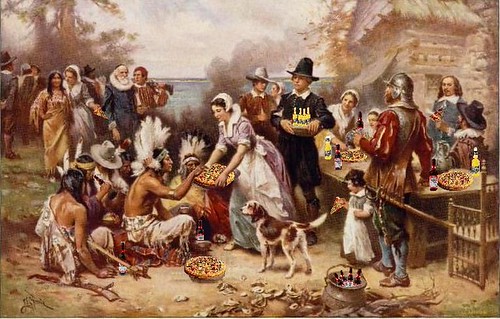
 First Fun Thanksgiving, after J.L.G. Ferris


Back in 2014, I wrote what may very well have been the best Guardian Liberty Voice article authored by me yet.

It was not read by too many people, I suspect. But that said, it was a good, solid article that explored the fascinating history of this holiday. I received compliments from the few people who I knew for sure had read the article, such as the editor. 

So, it seemed appropriate to publish it (or the link to it) yet again this year. Hope you enjoy!


I have wanted to do a history of the Thanksgiving holiday for a long time now. For whatever the reason, my assumption was that this had already been done to some extent on this blog page before but, when I checked earlier today, this was proven not to be the case.

Here is the thing about Thanksgiving: it is a great holiday, yet it also represents something terrible. That makes it a paradox, really. Let me explain.

The first time that I really came to understand the depth of the anger by Native Americans regarding the holiday was a number of years ago, after reading an article from Ward Churchill. He mentioned that celebrating Thanksgiving was essentially an insult to the native people, and that, in fact, it should be a day of mourning.

Since then, I have done further explorations, and even asked one native during a Pow Wow a couple of years or so back about it, and the answers have more or less been the same: Native Americans feel that this holiday represents an insult to their people, and a constant reminder that the holiday that we tend to think represents friendship and cooperation between Indians and Pilgrims actually represents the beginning of the end of their culture and traditional way of life.

For a little while, I was even entertaining the idea of abandoning the holiday, although this never actually came to pass.

Why?

Because it is a nice holiday, with a noble meaning, even if the holiday that it falls on is a bit tainted with history. But in researching for this article, and listening to Suzan Shown Harjo, as well as reading so0me of the arguments of those that went to Plymouth today to protest the holiday, made me realize that what needs to change is not perhaps the holiday itself, or what it is supposed to represent. Rather, what needs to change is the common misunderstanding about the origins of Thanksgiving, and why, specifically, natives find it offensive and representing something far more sinister than most popular perceptions.

If you are interested in finding out more, please start by reading my article by clicking on the link below, but also, do some of your own research. This is an important issue, and any American that feels some measure of patriotic duty should understand this history better, in order to come to terms with the darker aspects of our national past.

Also, one thing that bothers me about this holiday, or more this holiday weekend, is that it is immediately followed by Black Friday, which is perhaps the single day when, more than any other date on the calendar, represents our society's excessive greed and mindless consumerism. The fact that this comes literally the day after we are supposed to take time out to be thankful for all that we have been blessed with in life and that, furthermore, Black Friday is increasingly encroaching on the Thanksgiving holiday itself, is the height of hypocrisy. It suggests that there really is something wrong with this society, and we would do well, I think, not to simply shrug our shoulders or ignore it. We should recognize it, own up to it, and individually, refuse to participate in "Black Friday" deals and shopping, particularly with those stores that are trying to open up on Thanksgiving itself.

As I was driving past some malls earlier this evening, at an hour when the malls are usually closed and the vast parking lots normally deserted, I sighed at the sight of those parking lots almost filled to the brim. Thanksgiving was not yet officially over, and people surely were still feeling that heaviness from a huge dinner, and the fatigue from eating all of that turkey. Yet, so many people were out and about, hoping to horde as many great deals as possible, even though many retail stores jack up the prices prior to Black Friday before marking them down with significant seeming savings. It all seems so shady, such a scam, and it is more than a little disappointing to see greed win out on the part of all participants of this event.

Personally, I want absolutely no part of Black Friday, and urge any and all of you out there not to have anything to do with it, either. But ultimately, of course, that choice is yours to make.

Would have liked to get this published earlier. However, Thanksgiving is usually chaotic, between working overnight, getting a few hours of sleep, then eating a late Thanksgiving lunch with family, before going further south to meet my girlfriend, and head towards the place we have gone to the last three years. It has been a busy day, with very little time, as well as limited access, to the internet. So, I post this when I can.

Here is the link to my article, and I do hope that you take a look:


Thanksgiving Has a Controversial History


Friday, October 31, 2025

GLV Article (2015): Halloween Has a Haunted History


This was an article on the history of Halloween which I wrote for the Guardian Liberty Voice, and which was published around the time of Halloween.

Enjoy!

I recently wrote another article for the Guardian Liberty Voice. This one continues my tradition of exploring the history of certain holidays.


This time, obviously, the focus was on Halloween, which I think is appropriate for this time of the year.

Here is the link, and I do hope that you take a look! If not, the text of the article nonetheless can be found below:


Halloween Has a Haunted History:

http://guardianlv.com/2015/10/halloween-has-a-haunted-history-video/


Halloween
Halloween has grown as a major holiday so fast that it is downright spooky. It is the second biggest holiday for decorations, trailing only Christmas, and ne fourth of the candy sold in the United States os for Halloween. With Americans this year expected to spend fully $6.9 billion on the holiday, Halloween has become big business. The average American will spend up to $75 to celebrate the holiday, which for many will include decoration, costumes, parties, and giving candy away to children tracking through their neighborhoods while trick or treating.
It may surprise people to find out that many of these traditions that people have long associated with Halloween are not nearly as old as popularly believed, although the roots of the holiday stretch back to ancient times. What eventually would become our modern Halloween is over two thousand years old, tracing back to a couple of festivals - Sahmain and All Saints Day.
The Celtic festival of Sahmain came before Christianity. Literally translated from Gaelic, Samhain which was the term for the end of the summer. Back then, Celts lived in Ireland, Britain, and northwestern France, and this festival was widely celebrated. They would collect their earnings from farming, and would bring their animals in for the cold season to come. However, this time of the changing of the seasons was also popularly believed to possess supernatural powers. It was held on November 1, although it was believed that the night before Sahmain was a night when the world of the living and the world of the dead mixed. People would leave food and wine outside of their homes in hopes of preventing ghosts from coming in. Also, when people ventured out on such nights, they would wear masks in order to resemble ghosts.
In the eight century, Christians eliminated Sahmain and replaced it with All Saints Day, which was moved from mid-May to November by order of Pope Gregory III. This was done in an effort to eradicate the  pagan roots of this popular autumn festival. Despite this, All Saints Day, which was also known as All Hallows Mass and Hallowmas, never was fully divorced from the former autumn festival that it was meant to replace, and the evening before, which fell on the last day of October, came to be known as All Hallows' Eve. In time, people began a new tradition to scare away evil spirits, as they burned candles and carving turnips (the predecessor of the modern tradition of carving pumpkins).
The tradition of children and adults disguising themselves on All Hallow's Eve to ward off evil spirits also continued. Many would beg for food or coins during the All Souls' Day parade in England. Some families would give them pastries known as "soul cakes" and the beggars, in turn, were asked to pray for the deceased loved ones of the family giving the cakes. This may have been the origins of the modern "trick or treat" tradition that has become common on Halloween.
Ironically, despite Halloween having at least partial roots from the Christian tradition, the relationship between Halloween and Christians has often been complicated. October 31 happens to have been the day that Martin Luther essentially started the protestant Reformation in Wittenberg, Germany, in 1517, when he nailed his 95 Theses to a door. Most of the early Christians groups that came to America , greatly influenced by the Protestant Reformation and included the Pilgrims, the Puritans, the Quakers, and Baptists, rejected this holiday as pagan. Still, that ultimately did not prevent Halloween from traveling to American shores.
Halloween is a holiday that has changed greatly over the course of time. Late in the late nineteen century, many women believed that they could find out the identity of their future husbands through various means. Some of these methods involved hazelnuts, mirrors, apples, and yarn. Sometimes, a ring would be buried in food, in hopes that the one who discovered it would be moved to find real love. Also, the winner of apple bobbing competitions tended to be highly regarded as top prospects, as this was seen as a good sign. These traditions, however, generally faded over time.
It also used to have more in common with April Fool's Day, than with what most people today would consider typical of Halloween. Pranks were very common and quite popular, and some of the most popular pranks included throwing eggs at houses, opening up the gates of a farm, and making outhouses fall over. However, these tricks began to spiral out of control and become problematic, and so the focus began to emphasize the more innocent and less harmful traditions of candy and dressing up in costumes.
By Charles Bordeau
Sources:
Bustle.com: Why Do We Celebrate Halloween? 6 Facts About This Spooky Holiday's History
The Newnan Times-Herald: The history of Halloween
The Lincolnshire Echo: What is Halloween and why do we celebrate it?
Business.com: $6.9 Billion in Consumer Spending this Halloween is Spooky
NRF: The long and Short of America’s Consumer Holidays
Image courtesy of Nick Taylor's Flickr page: Pumpkin carving - Creative Commons License
Youtube video History of Halloween (The History Channel) courtesy of  Marco Gomez