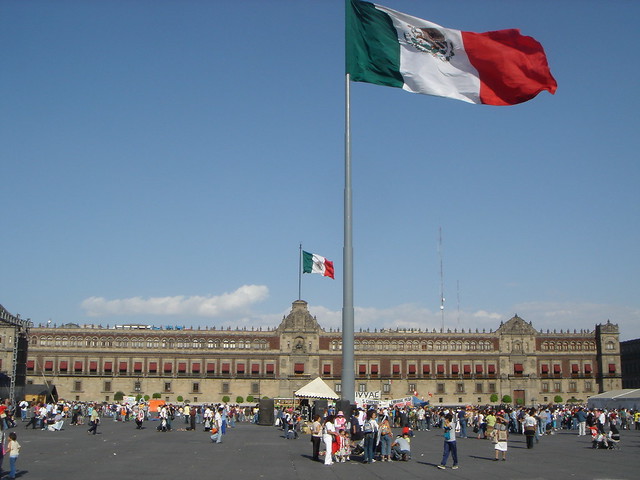
Ivan Hernández Flickr Page - Palacio Nacional - https://www.flickr.com/photos/ivanx/128248243
Creative Commons License: https://creativecommons.org/licenses/by/2.0/
Maybe these pictures are not nearly as impressive as the above picture of the Mexican flag at the Palacio Nacional in Mexico City, yet it is a much more personal one, taken as it was during the first crossing ever into Mexico that my son and I did during our first western trip back in August of 2015, when we crossed into Nogales, Mexico, from the town of the same name on the Arizona side. Ultimately, we took two trips out to Arizona, with these side excursions into Nogales, Mexico, and both my son and I enjoyed it very much!


We Americans have a troubled history with our neighbors to the south, Mexico. This was a nation that we went to war with, and if anything, we Americans were the aggressors. First, a bunch of Americans went to Texas, back when it was still a part of Mexico, and eventually insisted on gaining independence from Mexico. Eventually it led to war. Remember the Alamo? Well, despite how heroic we Americans tend to view the American/Texan role during that war, the main reason for that war, and for the Americans in Texas demanding independence from Mexico, was because slavery was illegal in Mexico. That is why the Texans rebelled, which means that Texas, specifically, fought in not one, but two major wars in order to preserve the institution of slavery there.
Then, of course, perhaps sensing blood and weakness, the still young United States waged a war in 1848 against Mexico. It was known as Polk's War by detractors, among whom were none other than Abraham Lincoln. Many Americans detested what they viewed as a war of aggression. But the United States fought the war, and wound up taking huge chunk of land away from Mexico thanks to the Treaty of Guadalupe Hidalgo. That includes all of the present day states of California, Nevada, and Utah, as well as huge parts of modern day Arizona, New Mexico, and Colorado, as well as even a part of modern day Texas. Later, there was the Gadsden in 1853, to add still more territory to the United States, in the southern parts of modern day Arizona (which includes regions where Nogales, as well as Tuscon, presently lie) and New Mexico. So, from the 1830's until the 1850's, there was hardly a good neighbor policy between the two nations and, if we are being fair, pretty much all of the aggression and hungry expansion was from one nation, the United States, at the expense of the other nation, Mexico.
There were other tense points between the two nations, as well. Pancho Villa became the first person to invade the United States, and the United States reciprocated, entering Mexico and hunting for Villa. He was never found by American forces, although Villa employed guerrilla warfare tactics. The venture ended once the United States entered World War I.
Of course, most of the tensions between the two countries since have been a little bit more subtle. For the most part, it has been about illegal immigration from Mexico into the United States. Many decades ago, while President Dwight D. Eisenhower was still in the Oval Office, millions of immigrants were sent back to Mexico from the United States, in what was known as "Operation Wetback."
This was largely a forgotten chapter in history, until the 2016 presidential election. For years, anti-immigrant sentiment was running high among millions of Americans. Many felt that Spanish was corrupting the purity of the English language, leading to English, for the first time in American history, being recognized as the official language of the United States during the term of George W. Bush. But anti-immigrant - and particularly anti-Mexican - sentiment ran especially high for the 2016 election.
This reached a high during the 2016 presidential election. When he announced his candidacy, Donald Trump infamously referred to Mexicans as rapists and criminals. Of course, he wanted to build a wall between the border to stem illegal immigration, and promised to force Mexico to pay for that wall. He urged his supporters to "mark my words."
They did not, and he never did get Mexico to pay for the wall. Tensions have not been higher in recent memory between the two countries.
Still, they are neighbors, and share some common chapters in history. There are millions of Mexican-Americans living in the United States, regardless of Trump and the anger and hatred of millions of Americans that he tapped into.
Mexico is a beautiful country. And even though it is not nearly as big of a deal in Mexico itself as it is here in the United States, this is my attempt to honor Mexico on this Cinqo de Mayo.
The U.S., Mexico And The Decline Of The Colorado River by Stratfor, Contributor, May 14, 2013:
https://www.forbes.com/sites/stratfor/2013/05/14/u-s-mexico-the-decline-of-the-colorado-river/#19ec5a647df1
We Americans have a troubled history with our neighbors to the south, Mexico. This was a nation that we went to war with, and if anything, we Americans were the aggressors. First, a bunch of Americans went to Texas, back when it was still a part of Mexico, and eventually insisted on gaining independence from Mexico. Eventually it led to war. Remember the Alamo? Well, despite how heroic we Americans tend to view the American/Texan role during that war, the main reason for that war, and for the Americans in Texas demanding independence from Mexico, was because slavery was illegal in Mexico. That is why the Texans rebelled, which means that Texas, specifically, fought in not one, but two major wars in order to preserve the institution of slavery there.
Then, of course, perhaps sensing blood and weakness, the still young United States waged a war in 1848 against Mexico. It was known as Polk's War by detractors, among whom were none other than Abraham Lincoln. Many Americans detested what they viewed as a war of aggression. But the United States fought the war, and wound up taking huge chunk of land away from Mexico thanks to the Treaty of Guadalupe Hidalgo. That includes all of the present day states of California, Nevada, and Utah, as well as huge parts of modern day Arizona, New Mexico, and Colorado, as well as even a part of modern day Texas. Later, there was the Gadsden in 1853, to add still more territory to the United States, in the southern parts of modern day Arizona (which includes regions where Nogales, as well as Tuscon, presently lie) and New Mexico. So, from the 1830's until the 1850's, there was hardly a good neighbor policy between the two nations and, if we are being fair, pretty much all of the aggression and hungry expansion was from one nation, the United States, at the expense of the other nation, Mexico.
There were other tense points between the two nations, as well. Pancho Villa became the first person to invade the United States, and the United States reciprocated, entering Mexico and hunting for Villa. He was never found by American forces, although Villa employed guerrilla warfare tactics. The venture ended once the United States entered World War I.
Of course, most of the tensions between the two countries since have been a little bit more subtle. For the most part, it has been about illegal immigration from Mexico into the United States. Many decades ago, while President Dwight D. Eisenhower was still in the Oval Office, millions of immigrants were sent back to Mexico from the United States, in what was known as "Operation Wetback."
This was largely a forgotten chapter in history, until the 2016 presidential election. For years, anti-immigrant sentiment was running high among millions of Americans. Many felt that Spanish was corrupting the purity of the English language, leading to English, for the first time in American history, being recognized as the official language of the United States during the term of George W. Bush. But anti-immigrant - and particularly anti-Mexican - sentiment ran especially high for the 2016 election.
This reached a high during the 2016 presidential election. When he announced his candidacy, Donald Trump infamously referred to Mexicans as rapists and criminals. Of course, he wanted to build a wall between the border to stem illegal immigration, and promised to force Mexico to pay for that wall. He urged his supporters to "mark my words."
They did not, and he never did get Mexico to pay for the wall. Tensions have not been higher in recent memory between the two countries.
Still, they are neighbors, and share some common chapters in history. There are millions of Mexican-Americans living in the United States, regardless of Trump and the anger and hatred of millions of Americans that he tapped into.
Mexico is a beautiful country. And even though it is not nearly as big of a deal in Mexico itself as it is here in the United States, this is my attempt to honor Mexico on this Cinqo de Mayo.
The U.S., Mexico And The Decline Of The Colorado River by Stratfor, Contributor, May 14, 2013:
https://www.forbes.com/sites/stratfor/2013/05/14/u-s-mexico-the-decline-of-the-colorado-river/#19ec5a647df1
The History Channel website did have something to say about the Cinqo de Mayo, although you have to search a little deeper. Here is what it says:
Cinco de Mayo—or the fifth of May—commemorates the Mexican army's 1862 victory over France at the Battle of Puebla during the Franco-Mexican War (1861-1867). A relatively minor holiday in Mexico, in the United States Cinco de Mayo has evolved into a celebration of Mexican culture and heritage, particularly in areas with large Mexican-American populations. Cinco de Mayo traditions include parades, mariachi music performances and street festivals in cities and towns across Mexico and the United States.
History of Cinco de Mayo: Battle of Puebla In 1861 the liberal Mexican Benito Juárez (1806-1872) became president of a country in financial ruin, and he was forced to default on his debts to European governments. In response, France, Britain and Spain sent naval forces to Veracruz to demand reimbursement. Britain and Spain negotiated with Mexico and withdrew, but France, ruled by Napoleon III (1808-1873), decided to use the opportunity to carve a dependent empire out of Mexican territory. Late in 1861, a well-armed French fleet stormed Veracruz, landing a large French force and driving President Juárez and his government into retreat.
Certain that success would come swiftly, 6,000 French troops under General Charles Latrille de Lorencez (1814-1892) set out to attack Puebla de Los Angeles, a small town in east-central Mexico. From his new headquarters in the north, Juárez rounded up a rag-tag force of 2,000 loyal men—many of them either indigenous Mexicans or of mixed ancestry—and sent them to Puebla. Led by Texas-born General Ignacio Zaragoza (1829-1862), the vastly outnumbered and poorly supplied Mexicans fortified the town and prepared for the French assault. On May 5, 1862, Lorencez drew his army, well provisioned and supported by heavy artillery, before the city of Puebla and led an assault from the north. The battle lasted from daybreak to early evening, and when the French finally retreated they had lost nearly 500 soldiers. Fewer than 100 Mexicans had been killed in the clash.
Although not a major strategic win in the overall war against the French, Zaragoza's success at Puebla represented a great symbolic victory for the Mexican government and bolstered the resistance movement. Six years later—thanks in part to military support and political pressure from the United States, which was finally in a position to aid its besieged neighbor after the end of the Civil War—France withdrew. The same year, Austrian Archduke Ferdinand Maximilian, who had been installed as emperor of Mexico by Napoleon in 1864, was captured and executed by Juárez's forces. Puebla de Los Angeles was renamed for General Zaragoza, who died of typhoid fever months after his historic triumph there.
Cinco de Mayo in Mexico
Within Mexico, Cinco de Mayo is primarily observed in the state of Puebla, where Zaragoza’s unlikely triumph occurred, although other parts of the country also take part in the celebration. Traditions include military parades, recreations of the Battle of Puebla and other festive events. For many Mexicans, however, May 5 is a day like any other: It is not a federal holiday, so offices, banks and stores remain open.
Cinco de Mayo in the United States
In the United States, Cinco de Mayo is widely interpreted as a celebration of Mexican culture and heritage, particularly in areas with substantial Mexican-American populations. Chicano activists raised awareness of the holiday in the 1960s, in part because they identified with the victory of indigenous Mexicans over European invaders during the Battle of Puebla. Today, revelers mark the occasion with parades, parties, mariachi music, Mexican folk dancing and traditional foods such as tacos and mole poblano. Some of the largest festivals are held in Los Angeles, Chicago and Houston.
Confusion with Mexican Independence Day
Many people outside Mexico mistakenly believe that Cinco de Mayo is a celebration of Mexican independence, which was declared more than 50 years before the Battle of Puebla. That event is commemorated on September 16, the anniversary of the revolutionary priest Miguel Hidalgo y Costilla’s famous “Grito de Dolores” (“Cry of Dolores”), a call to arms that amounted to a declaration of war against the Spanish colonial government in 1810.
Here is an article on it from the National Geographic Website:
Cinco de Mayo History: From Bloodshed to Beer Fest
The history of Cinco de Mayo: from Mexican battle to U.S. bacchanal.
Stefan Lovgren in Los Angeles for National Geographic News
Updated May 5, 2010
Today fiesta lovers across the United States will gather to celebrate the Mexican holiday Cinco de Mayo—literally "May 5" in Spanish. And some U.S. partygoers may be surprised to learn that Cinco de Mayo history is short on beer, long on bloodshed.
Cinco de Mayo is often mistaken for Mexican Independence Day, which is actually September 16. On that date in 1810, Mexico declared its independence from Spanish rule. (Related blog post: Cinco de Mayo in any language.)
Cinco de Mayo actually commemorates the Mexican army's unlikely defeat of French forces at the Battle of Puebla on May 5, 1862. Yet Cinco de Mayo is celebrated only sporadically in Mexico, mainly in the southern town of Puebla (see map of Puebla) and a few larger cities.
In recent years, though, Cinco de Mayo rapidly gained popularity in the U.S., where changing demographics have helped to turn the holiday into a cultural event. Latinos are the largest minority in the U.S. today with 44.3 million people, representing 15 percent of the population, according to a July 2008 U.S. Census Bureau report.
A 1998 study in the Journal of American Culture found that the number of official U.S. celebrations of Cinco de Mayo topped 120.
In 2006 the number of official Cinco de Mayo events was 150 or more, according to José Alamillo, professor of ethnic studies at Washington State University in Pullman, who has studied the cultural impact of Cinco de Mayo north of the border.
Cinco de Mayo is even celebrated in towns across the U.S. that are predominately non-Hispanic, he noted.
"Cinco de Mayo, he said, is "definitely becoming more popular than St. Patrick's Day."
(Related blog post: Happy Cinco de Mayo!)
Cinco de Mayo History: Battle of Puebla In 1862 a Mexican militia led by General Ignacio Zaragoza defeated far better equipped French expeditionary forces on Cinco de Mayo.
Emperor Napoleon III had sent French troops to Mexico to secure dominance over the former Spanish colony and install one of his relatives, Archduke Maximilian of Austria, as its ruler.
Zaragoza won the battle, but the Mexicans ultimately lost the war. Maximilian became Mexico's emperor for three years before the country reclaimed its independence.
Cinco de Mayo: From Brotherly Love to Chicano Power
Cinco de Mayo gained its first popularity in the U.S. in the 1950s and 1960s, partly because of an outpouring of brotherly love, Alamillo says.
"The reason it became more popular [in the U.S. during that time] was in part because of the Good Neighbor policy," he said, referring to a U.S. government effort at the time to reach out to neighboring countries.
"Cinco de Mayo's purpose was to function as a bridge between these two cultures," Alamillo said.
The holiday's popularity really grew in the 1960s, when Mexican-American, or Chicano, activists embraced the holiday as a way to build pride among Mexican Americans, Alamillo says.
The 1862 Cinco de Mayo victory carries a strong anti-imperialist message that resonates with many Mexican Americans, experts say.
"As a community, we are tough and committed, and we believe that we can prevail," said Robert Con Davis-Undiano, a professor of Chicano studies at the University of Oklahoma in Norman.
"That was the attitude of the ragtag Mexican troops who faced and defeated the French in Puebla," he said.
"And Mexican Americans, other Latinos, and literally everyone can feel proud and motivated by that message."
At the same time, Cinco de Mayo was transformed from a strictly nationalist celebration to a bicultural event that expressed the Mexican Americans' identity, Washington State's Alamillo says.
"It allowed for Anglo-Americans to partake in and learn about Mexican culture through Cinco de Mayo," Alamillo said. (Celebrate Cinco de Mayo with pictures of Mexico.)
"Mexican Americans by this point were interested in building this relationship, because they were asking for certain political demands and for more resources for the community.
"It became a really interesting negotiation festival in a lot of ways."
Cinco de Mayo: From Culture to Commercialism
Then came the 1980s, and the commercialization of Cinco de Mayo.
This, Alamillo says, is when the meaning of Cinco de Mayo changed from community self-determination to a drinking holiday for many people.
He says U.S. corporations, particularly those selling alcohol, were eager to tap into the expanding Hispanic population in the U.S.
"It's not just the large number of the Hispanics but also that it's a very young population that is particularly receptive to advertisers," Alamillo said.
"Cinco de Mayo became a vehicle to tap into that market."
Davis-Undiano, the University of Oklahoma professor, still sees Cinco de Mayo as a positive force that can bring Latinos and non-Latinos together, especially at a time when tensions surrounding the illegal immigration debate run high.
(Related news: "U.S. Immigration Law Could Harm Desert Animals, Critics Say.")
"I'm convinced there is a lot of unprocessed anxiety among non-Latinos concerning what changes that will come with a much larger Latino population," he said.
"Cinco de Mayo gives everyone a chance to feel like a single community."
Original version posted May 5, 2006
Finally, I thought it appropriate to get a more historical perspective from a Mexican (or what purports to be Mexican, in any case) website. So here is the history, according to Mexonline.com: http://www.mexonline.com/cinco-de-mayo.htm
Introduction
The holiday of Cinco De Mayo, The 5th Of May, commemorates the victory of the Mexican militia over the French army at The Battle Of Puebla in 1862. It is primarily a regional holiday celebrated in the Mexican state capital city of Puebla and throughout the state of Puebla, with some limited recognition in other parts of Mexico, and especially in U.S. cities with a significant Mexican population. It is not, as many people think, Mexico's Independence Day, which is actually September 16.
Setting The Stage
The battle at Puebla in 1862 happened at a violent and chaotic time in Mexico's history. Mexico had finally gained independence from Spain in 1821 after a difficult and bloody struggle, and a number of internal political takeovers and wars, including the Mexican-American War (1846-1848) and the Mexican Civil War of 1858, had ruined the national economy.
During this period of struggle Mexico had accumulated heavy debts to several nations, including Spain, England and France, who were demanding repayment. Similar debt to the U.S. was previously settled after the Mexican-American War. France was eager to expand its empire at that time, and used the debt issue to move forward with goals of establishing its own leadership in Mexico. Realizing France's intent of empire expansion, Spain and England withdrew their support. When Mexico finally stopped making any loan payments, France took action on its own to install Napoleon III's relative, Archduke Maximilian of Austria, as ruler of Mexico. Mexico Confronts
The Invasion
France invaded at the gulf coast of Mexico along the state of Veracruz (see map) and began to march toward Mexico City, a distance today of less than 600 miles. Although American President Abraham Lincoln was sympathetic to Mexico's cause, and for which he is honored in Mexico, the U.S. was involved in its own Civil War at the time and was unable to provide any direct assistance.
Marching on toward Mexico City, the French army encountered strong resistance near Puebla at the Mexican forts of Loreto and Guadalupe. Lead by Mexican General Ignacio Zaragoza Seguin, a smaller, poorly armed militia estimated at 4,500 men were able to stop and defeat a well outfitted French army of 6,500 soldiers, which stopped the invasion of the country. The victory was a glorious moment for Mexican patriots, which at the time helped to develop a needed sense of national unity, and is the cause for the historical date's celebration.
Unfortunately, the victory was short lived. Upon hearing the bad news, Napoleon III had found an excuse to send more troops overseas to try and invade Mexico again, even against the wishes of the French populace. 30,000 more troops and a full year later, the French were eventually able to depose the Mexican army, take over Mexico City and install Maximilian as the ruler of Mexico.
Maximilian's rule of Mexico was also short lived, from 1864 to 1867. With the American Civil War now over, the U.S. began to provide more political and military assistance to Mexico to expel the French, after which Maximilian was executed by the Mexicans - his bullet riddled shirt is kept at the museum at Chapultepec Castle in Mexico City. So despite the eventual French invasion of Mexico City, Cinco de Mayo honors the bravery and victory of General Zaragoza's smaller, outnumbered militia at the Battle of Puebla in 1862.
Today's Celebration
For the most part, the holiday of Cinco de Mayo is more of a regional holiday in Mexico, celebrated most vigorously in the state of Puebla. There is some limited recognition of the holiday throughout the country with different levels of enthusiasm, but it's nothing like that found in Puebla.
Celebrating Cinco de Mayo has become increasingly popular along the U.S.-Mexico border and in parts of the U.S. that have a high population of people with a Mexican heritage. In these areas the holiday is a celebration of Mexican culture, of food, music, beverage and customs unique to Mexico.
Commercial interests in the United States and Mexico have also had a hand in promoting the holiday, with products and services focused on Mexican food, beverages and festivities, with music playing a more visible role as well. Several cities throughout the U.S. hold parades and concerts during the week following up to May 5th, so that Cinco de Mayo has become a bigger holiday north of the border than it is to the south, and being adopted into the holiday calendar of more and more people every year.
[Sources: Encyclopedia Encarta, Encyclopedia Britanica, Prescott's Mexico:1900, HistoryChannel.com, other sources. minor edits April 25, 2007]