Tuesday, December 31, 2024

Book Review: Eyes of the Dragon by Stephen King


After reading "Fairy Tale" by Stephen King last year, I had a desire to read this particular book once again, for the first time in...well, a long time. Think it was over two decades ago when I had read it.

It was just that these two books reminded me quite a bit of one another. They are different, to be sure. In fact, they may be more different than similar.

Yet, they also stand out within the body of work by King, because they both harken back to themes that are more similar to fairy tales, rather than the more conventional books by him, most of which take place in Maine (although sometimes in other places, such as Colorado), and which generally take place during modern times. In fact, "Fairy Tale" actually at least partially is like that itself, taking place in modern times, although the main character travels through some kind of tunnel that traverses across worlds, and where he finds himself in another world altogether. A world which seems similar to our fairy tales. 

Similar, yes.

Identical, no.

While I really enjoyed both books, I actually probably preferred "Fairy Tale." It begins with an ordinary person, a teenaged boy who accidentally discovers a portal between two worlds. The other world which he discovers is, of course, a fairy tale world brought to real life.

"Eyes of the Dragon" is, by contrast, much closer to reading like an actual fairy tale. It takes place at a time or place very similar to a fairy tale. That said, it feels a little bit more realistically than your typical fairy tale would. There is a part towards the end where this book feels like horror, and was eerily reminiscent of The Shining, at least to me. Of course, Stephen King is known as the "master of horror," so that makes sense. 

However, it is not a horror book. Not really. In fact, it is very different than almost any other King book. Now, the closest comparison would be "Fairy Tale," although as stated earlier, there are actually some significant differences between the two books.

Without going into too many details, much less spoilers, what happens is that there is basically an evil wizard. His name is Randall Flagg, and that much will feel familiar to fans of Stephen King, since this is a recurring character. Well, he wants to create turmoil in a kingdom. He has rough control over the king, but he worries about Peter, the king's eldest son, who is heir to the throne. So the magician orchestrates for the king to be murdered, and then to pin it all on Peter. Meanwhile, Thomas becomes the king, and Flagg controls him. Peter is imprisoned, and the world seems to think that he murdered his own father, the king. Things in the kingdom are no better, as the wizard orchestrates chaos in the form of crushing taxes and other burdens for the people.

As it turns out, only Peter can save the kingdom by clearing his name and assuming his right to the throne. Soon, he begins to have allies whom will help him. Eventually, however, the very powerful wizard, Flagg, catches on, while a massive snowstorm brews around the castle where Peter has been imprisoned for five years. 

Good stuff.

It is strange how a book can be very different when you read it again after many years, or even decades. There were things about this book which felt very familiar, and other aspects which I could not recall. Some of it almost felt new to me, in fact.

While this is hardly a typical King book, it nevertheless is a good read. King is a master of storytelling. His characters are rich with life, largely because they are relatable. And while these characters are perhaps a bit less so than some of this other works - remember, this is a fairy tale-styled book - it nevertheless is a good story and an enjoyable read.

Highly recommended!


December 31st: This Day in History


Once again, it should be reiterated, that this does not pretend to be a very extensive history of what happened on this day (nor is it the most original - the links can be found down below). If you know something that I am missing, by all means, shoot me an email or leave a comment, and let me know!


On this day in 406, Vandals, Alans and Suebians crossed the Rhine River and began an invasion of Gallia. In 535 on this day, Byzantine General Belisarius completed the conquest of Sicily, defeating the Ostrogothic garrison of Syracuse, and ending his consulship for the year. On this day in 1600, a formal charter was granted to the East India Company by Queen Elizabeth I, as she hoped to break the Dutch monopoly of the spice trade in what is now Indonesia. On this day in 1775 during the American Revolution, Patriot forces under generals Benedict Arnold and Richard Montgomery were defeated by the British in the the city of Quebec, Canada.  Montgomery was killed during the battle. In 1805 on this day came the end of the French Republican calendar; France returned to the traditional Gregorian calendar. In 1944 on this day, the provisional government of Hungary declared war on Germany, bringing an end to Hungary's cooperation—sometimes free, sometimes coerced—with the Axis power. On this day in 1970, Paul McCartney effectively officially ended the Beatles when he sued John Lennon, George Harrison, and Richard Starkey (Ringo Starr) in the London High Court's Chancery Division, seeking “a declara- tion that the partnership business . . . be dissolved.” In 1978 on this day, the United States ended official relations with Nationalist China. On this day in 1999, the United States officially turned the Panama Canal over to Panama. Also on this day in 1999, Boris Yeltsin resigned as President of Russia, leaving Prime Minister Vladimir Putin as the acting President.


Here's a more detailed look at events that transpired on this date throughout history:

406 - 80,000 Vandels attack the Rhine at Mainz


On this day in 406, Vandals, Alans and Suebians crossed the Rhine River and began an invasion of Gallia. In 535 on this day, Byzantine General Belisarius completed the conquest of Sicily, defeating the Ostrogothic garrison of Syracuse, and ending his consulship for the year. 

765 - Coffin of Ho-tse Shen-hui interred in a stupa built in China
870 - Skirmish at Englefield: Ethelred of Wessex beats Danish invasion army
1229 - James I of Aragon the Conqueror enters Medina Mayurqa (now known as Palma, Spain) thus consummating the Christian conquest of the island of Majorca.
1492 - 100,000 Jews expelled from Sicily
1502 - Cesare Borgia (son of pope Alexander VI) occupies Urbino
1564 - Willem van Orange demands freedom of conscience/religion


On this day in 1600, a formal charter was granted to the East India Company by Queen Elizabeth I, as she hoped to break the Dutch monopoly of the spice trade in what is now Indonesia. 

1604 - Admiral Steven van der Haghen's fleet reaches Bantam
1621 - Hungarian King Bethlen Gabor/Ferdinand II sign Treaty of Mikulov
1660 - James II of England is named Duke of Normandy by Louis XIV of France.
1669 - France & Brandenburg sign secret treaty
1670 - France & England sign Boyne-treaty
1680 - Amsterdam opera at Leidsegracht opens
1687 - 1st Huguenots depart France to Cape of Good Hope
1688 - Pro-James II-earl of Devonshire occupies Nottingham [OS=Dec 21]
1695 - A window tax is imposed in England, causing many shopkeepers to brick up their windows to avoid the tax.
1700 - Frisia/Groningen adopt Gregorian calendar, tomorrow is 1/12/1701
1708 - Great Alliance captures Bridge
1711 - Duke of Marlborough fired as English army commander
1744 - James Bradley announces discovery of Earth's nutation motion (wobble)
1745 - Bonnie Prince Charlies army meets with de Esk
1756 - Russia joins the Alliance of Versailles
1758 - British expeditionary army occupies Goree (Dakar) Senegal


On this day in 1775 during the American Revolution, Patriot forces under generals Benedict Arnold and Richard Montgomery were defeated by the British in the the city of Quebec, Canada.  Montgomery was killed during the battle.  

1776 - Rhode Island establishes wage & price controls to curb inflation: Limit is 70 cents a day for carpenters, 42 cents for tailors
1779 - English fleet beat Dutch Merchant vessels
1781 - Bank of North America, 1st US bank opens
1783 - Import of African slaves banned by all of the Northern states


The new calendar that was to replace the Gregorian calendar.


In 1805 on this day came the end of the French Republican calendar; France returned to the traditional Gregorian calendar.

1831 - Gramercy Park is deeded to New York City.
1841 - Alabama becomes 1st state to license dental surgeons
1857 - Queen Victoria chooses Ottawa as new capital of Canada
1859 - Dutch colony in Dutch Indies counts 4,800 slaves
1861 - 22,990 mm of rain falls in Cherrapunji Assam in 1861, world record
1862 - -Jan 20th) Battle of Stone's River/Battle of Murfreesboro, Tennesse in American Civil War
1862 - President Lincoln signs act admitting West Virginia to the Union
1862 - Skirmish at Parker Cross Roads, Tennessee
1862 - Union ironclad ship "Monitor" sank off Cape Hatteras, NC
1870 - J D Schneiter patents rocket mail in France, (not done)
1879 - Cornerstone laid for Iolani Palace (only royal palace in US)
1879 - Cornerstone laid for Honolulu's Iolani Palace
1879 - Edison gives 1st public demonstration of his incandescent lamp
1879 - Gilbert and Sullivan's Opera "Pirates of Penzance," premieres in NYC
1890 - Ellis Island (NYC) opens as a US immigration depot
1896 - 25th auto built in US
1897 - Brooklyn's last day as a city, it incorporates into NYC (1/1/1898)
1902 - Boers & British army sign peace treaty
1904 - The first New Year's Eve celebration is held in Times Square, then known as Longacre Square, in New York, New York.
1906 - French/British/Italian treaty concerning rights on Abyssinia
1907 - For 1st time a ball drops at Times Square to signal new year
1907 - G Mahler conducts the Metropolitan Opera
1910 - US tobacco industry produced 9 billion cigarettes in 1910
Discoverer of Radium Marie CurieDiscoverer of Radium Marie Curie 1911 - Marie Curie receives her 2nd Nobel Prize
1914 - Colonel Jacob Ruppert & Cap Huston purchase NY Yankees for $460,000
1917 - Dutch Social-democratic trade union NVV counts 159,450 members
1918 - Kid Gleason replaces Pants Rowland as White Sox manager
1920 - Roy Park makes 1st-ball duck in only Test Cricket inn, v Eng at MCG
1921 - Last San Francisco firehorses retired
1923 - 1st transatlantic radio broadcast of a voice, Pittsburgh-Manchester
1923 - BBC begins using Big Ben chime ID
1923 - H Tierney/J McCarthy's musical "Kid Boots," premieres in NYC
1924 - Hubble announces existence of distant galaxies
1925 - 14th congress of CPSU decides to accelerate industry
1927 - Ponsford scores 336 against SA, giving him 1146 for month
1929 - Pope Pius XI publishes encyclical Divini illius magistri
1930 - Pontifical encyclical Casti connubii against mixed marriages
1930 - US tobacco industry produced 123 billion cigarettes in 1930
1932 - John P O'Brien sworn-in as mayor of NYC
1934 - Helen Richey becomes 1st woman to pilot an airmail transport
1935 - CPH becomes Dutch Communist Party
1935 - Charles Darrow patents Monopoly
1938 - Dr R N Harger's "drunkometer," 1st breath test, introduced in Indiana
1938 - Dutch national debt hits ƒ3,986,629,805.70
1939 - 25 U boats sunk this month (81,000 ton)
1939 - Dutch national debt hits ƒ4,218,553,180.99
1940 - 37 U boats sunk this month (213,000 ton)
1941 - Young Park (2) in the Bronx named in honor of Samuel Young
1942 - 60 U boats sunk this month (330,000 ton)
1942 - Battle in Barents Sea
1942 - Potatoes rationed in Holland
Singer/Actor Frank SinatraSinger/Actor Frank Sinatra 1943 - NYC's Times Square greets Frank Sinatra at Paramount Theater
1944 - 48 people die in a train accident in Ogden, Utah
1944 - Japanese army evacuates harbor city Akyab

In 1944 on this day, the provisional government of Hungary declared war on Germany, bringing an end to Hungary's cooperation—sometimes free, sometimes coerced—with the Axis power. 


1945 - Bradman scores 112, his 1st post-War century, SA v Aust Services
1945 - Ratification of UN Charter completed
1946 - French troops leave Lebanon
1946 - Pres Harry Truman officially proclaims end of WW II
1948 - Dutch police actions up Java gone on strike
1949 - 18 countries recognize Republic Indonesia
1950 - Jockeys W Shoemaker & Joe Culmone set record of 388 wins in a year
1951 - 1st battery to convert radioactive energy to electrical announced
1953 - Hulan Jack sworn in as Manhattan Borough president
1953 - WFBC (now WYFF) TV channel 4 in G'ville-Spartanburg, SC (NBC) begins
1953 - Willie Shoemaker shatters record, riding 485 winners in a year
33rd US President Harry Truman33rd US President Harry Truman 1955 - "Vamp" closes at Winter Garden Theater NYC after 60 performances
1955 - The General Motors Corporation becomes the first U.S. corporation to make over $1 billion USD in a year.
1957 - AAU awards Bobby Morrow, James Sullivan Memorial Trophy
1958 - 47th Davis Cup: USA beats Australia in Brisbane (3-2)
1958 - Cuban dictator Batista tells his Cabinet he is fleeing the country
1958 - International Geophyscial Year ends
1958 - Willie Shoemaker 1st jockey to win national riding championship 4X
1961 - "lrma La Douce" closes at Plymouth Theater NYC after 527 performances
1961 - 1st performance of Beach Boys
1961 - Beach Boys play their debut gig under that name
1961 - Failed coup by Syrian group in Lebanon
1961 - Green Bay Packers shutout NY Giants 37-0 in NFL championship game
1961 - Marshall Plan expires after distributing more than $12 billion
1962 - "Match Game" debuts on NBC with host Gene Rayburn
1962 - American Basketball League announces suspension of operation
1962 - Dutch leave New Guinea
1962 - Katanga becomes part of Democratic Republic of Congo
1962 - Ohio ends suit against Reds when they agree to stay in Cin for 10 yrs
1963 - Chicago Bears win NFL championship
1963 - Dear Abby show premieres on CBS radio (runs 11 years)
1963 - Jerry Garcia & Bob Weir played music together for the 1st time
Cuban President and Dictator Fulgencio BatistaCuban President and Dictator Fulgencio Batista 1964 - Donald Campbell (UK) sets world water speed record (276.33 mph)
1964 - Indonesia proclaims expelled from the UN
1966 - Monkee's "I'm a Believer" hits #1 & stays there for 7 weeks
1966 - Pirate Radio 390 (Radio Invicata) off England, resumes transmitting
1966 - Test Cricket debut of Bishen Singh Bedi, India v WI Calcutta, 2-92
1966 - Toboggan Chutes begin operation in Cleveland Metroparks
1967 - "Henry, Sweet Henry" closes at Palace Theater NYC after 80 perfs
1967 - 1st NBA game at Great Western Forum, LA Lakers beat Houston 147-118
1967 - Oakland Raiders beat Houston Oilers 40-7 in AFL championship game
1967 - Packers beat Cowboys 21-17 in NFL championship game (-13°F)
1968 - 1st supersonic airliner flown (Russian TU-144)
1968 - 1st test flight of Tupolev TU 144
1968 - NY Jets win AFL championship
1969 - Congo-Brazzaville becomes People's republic, under major Ngouabi
1970 - Congress authorizes Eisenhower dollar coin


On this day in 1970, Paul McCartney effectively officially ended the Beatles when he sued John Lennon, George Harrison, and Richard Starkey (Ringo Starr) in the London High Court's Chancery Division, seeking “a declara- tion that the partnership business . . . be dissolved.”

1970 - President Allende nationalizes Chilean coal mines
1970 - Would have been start of Aust/Eng Test Cricket at MCG, washed out
1971 - KAID TV channel 4 in Boise, ID (PBS) begins broadcasting
1971 - Lt Gen Robert E Cushman, Jr, USMC, ends term as deputy director of CIA
1972 - 39th Sugar Bowl: Oklahoma 14 beats Penn State 0
1972 - Leap second day; also in 1973-79, 1987
1972 - Miami Dolphins beat Pittsburgh Steelers 21-7 in AFC championship game
1972 - Washington Redskins beat Dallas Cowboys 26-3 in NFC championship game
1973 - 40th Sugar Bowl: Notre Dame 24 beats Alabama 23
1973 - 61st Australian Mens Tennis: John Newcombe beats O Parun (63 67 75 61)
1973 - Johan Cruyff chosen European soccer Player of year
1974 - 41st Sugar Bowl: Nebraska 13 beats Florida 10
1974 - Gold legal in US, Franklin Mint strikes Panama's Gold 100 balboa coin
1974 - Lindsey Buckingham & Stevie Nicks join Fleetwood Mac
1974 - NY Yankees sign Jim "Catfish" Hunter for 5 yrs for a record $3.75 million
1974 - Popular Electronics displays Altair 8800 computer
1975 - 42nd Sugar Bowl: Alabama 13 beats Penn State 6
1976 - TV soap "Somerset" ends 6 year run
1976 - The Cars played their 1st gig
1977 - "Bubbling Brown Sugar" closes at ANTA Theater NYC after 766 perfs
1977 - "Man of La Mancha" closes at Palace Theater NYC after 124 performances
1977 - Amir Sheikh Jabir al-Ahmad al-Jabir Al Sabah becomes leader of Kuwait
1977 - Cambodia drops diplomatic relations with Vietnam
1977 - Donald Woods, a banned white editor flees South Africa
1977 - Ted Bundy escapes from jail in Colorado
1977 - WFAT (Brooklyn New York pirate radio station) begins broadcasting on 1620 AM
1978 - "Magic Show" closes at Cort Theater NYC after 1859 performances
1978 - "Runaways" closes at Plymouth Theater NYC after 199 performances
1978 - CIA director, Admiral Stansfield Turner retires from the Navy
1978 - Iran shah names Chapour Bakhtiar premier
1978 - Taiwan's final day of diplomatic relations with US

In 1978 on this day, the United States ended official relations with Nationalist China  Flags at both the American embassy in Taipei and the Taiwanese embassy in the United States are lowered for the last time as U.S. relations with Taiwan officially come to an end. On January 1, 1979 the United States officially recognized the government of the People's Republic of China in Beijing.  

1979 - Winterland Rock Concert Hall in SF closes after 556 concerts
1980 - A Jewish owned hotel in Nairobi Kenya is bombed killing 18
1980 - NY Islanders greatest shutout margin (9-0) vs Chicago Black Hawks
1980 - Senegal president Leopold Senghor resigns
1981 - CNN Headline News debuts
1981 - Lt Jerry Rawlings becomes head of Ghana, suspends constitution
1981 - Netherlands unemployment stands at record 475,000
1982 - CBS Mystery Theater final episode on radio after 8 years
1982 - NBC radio cancels almost all of its network daily features
1982 - TV soap "Doctors" ends 19 year run
1983 - Brunei gains complete independence from Britain
1983 - Jose Happart installed as mayor of Voeren Belgium
1983 - Nigeria's National Assembly dissolves after military coup
1984 - Def Leppard drummer Rick Allen loses his arm in a car crash
1984 - NYC subway gunman Bernhard Goetz surrenders to police in NH
1984 - Rajiv Gandhi takes office as India's 6th PM succeeding his mother Indira Gandhi
1984 - Test Cricket debut of Mohammad Azharuddin, v England at Calcutta
1984 - US leaves UNESCO
1986 - Dupont Plaza Hotel fire in San Juan, Puerto Rico kills 97
1986 - Russian TU-144 flies for 1st time faster than sound
1986 - WIS-AM in Columbia SC changes call letters to WVOC (now WOMG)
1989 - "Me & My Girl" closes at Marquis Theater NYC after 1420 performances
1989 - "Threepenny Opera" closes at Lunt-Fontanne Theater NYC after 65 perfs
1989 - Fog Bowl: Heavy fog rolls in on Bears 20-12 victory over Eagles
1989 - Jockey Kent Desormeaux sets record with 598 wins in a year
1990 - Iraq begins a military draft of 17 year olds
1990 - Sci-Fi Channel on cable TV begins transmitting
1990 - United Somali Congress seizes Presidential Palace
1991 - CPN, Communist Party of Netherland, last day of existance
1991 - Daniel R McCarthy elected NY Yankee managing general partner
1991 - Dow Jones closes at record high 3168.83
1991 - J Donald Crump resigned as CFL Commissioner
1991 - USSR, last day of existence
1992 - Target date for Europe's single market
1993 - Barbra Striesand does her 1st live public concert in 20 years
1994 - 1st snowless December in Baltimore Maryland
1994 - Anti Apartheid Group of Netherlands (AABN) disbands
1994 - This date is skipped altogether in Kiribati as the Phoenix Islands and Line Islands change time zones from UTC-11 to UTC+13 and UTC-10 to UTC+14, respectively.
1995 - "Danny Gans on Broadway" closes at Neil Simon NYC
1995 - "Having Our Say" closes at Booth Theater NYC after 308 performances
1995 - "Heiress" closes at Cort Theater NYC after 340 performances
1995 - "Paul Roebson" closes at Longacre Theater NYC after 14 performances
1995 - "Racing Demon" closes at Vivian Beaumont Theater NYC after 48 perfs
1995 - "Tempest" closes at Broadhurst Theater NYC after 71 performances
1995 - 62nd Sugar Bowl: Virginia Tech beats Texas
1995 - Cartoonist Bill Watterson ends his "Calvin & Hobbes" comic strip
1995 - Matthew Elliott scores separate cricket century same day for Victoria
1997 - Intel cuts price of Pentium II-233 MHz from $401 to $268
1997 - Marv Levy, retires as coach of Buffalo Bills
1997 - Microsoft buys Hotmail E-mail service
1997 - More Swedes died than were born in 1997, 1st time since 1809
1997 - Orlando Hernandez, half-brother of pitcher Livan, defects from Cuba
1997 - S Afr & US surgeons separate Zambian Siamese twins joined at the head
1998 - US movie box office hits record $6.24 billion for year
1998 - Exchange rates between the euro and legacy currencies in the Eurozone become fixed.


On this day in 1999, the United States officially turned the Panama Canal over to Panama. Also on this day in 1999, Boris Yeltsin resigned as President of Russia, leaving Prime Minister Vladimir Putin as the acting President.


2004 - The official opening of Taipei 101, the current tallest skyscraper in the world, standing at a height of 509 metres (1,670 feet).
2007 - Bocaue Fire. Seven people injured when a fire razed several fireworks stores in the Municipality of Bocaue, Bulacan, Philippines.
2007 - The Massive Big Dig construction project in Boston, Massachusetts ends.


1687 - The first Huguenots set sail from France for the Cape of Good Hope, where they would later create the South African wine industry with the vines they took with them on the voyage.   1695 - The window tax was imposed in Britain, which resulted in many windows being bricked up.   1711 - The Duke of Marlborough was dismissed as commander-in-chief.   1775 - The British repulsed an attack by Continental Army generals Richard Montgomery and Benedict Arnold at Quebec. Montgomery was killed in the battle.   1841 - The State of Alabama enacted the first dental legislation in the U.S.   1857 - Britain's Queen Victoria decided to make Ottawa the capital of Canada.   1862 - U.S. President Lincoln signed an act admitting West Virginia to the Union.   1877 - U.S. President Rutherford B. Hayes became the first U.S. President to celebrate his silver (25th) wedding anniversary in the White House.   1879 - Thomas Edison gave his first public demonstration of incandescent lighting to an audience in Menlo Park, NJ.   1891 - New York's new Immigration Depot was opened at Ellis Island, to provide improved facilities for the massive numbers of arrivals.   1897 - Brooklyn, NY, spent its last day as a separate entity before becoming part of New York City.   1923 - In London, the BBC first broadcast the chimes of Big Ben.   1929 - Guy Lombardo and his Royal Canadians played "Auld Lang Syne" as a New Year's Eve song for the first time.   1946 - U.S. President Truman officially proclaimed the end of hostilities in World War II.   1947 - Roy Rogers and Dale Evans were married.   1953 - Willie Shoemaker broke his own record as he won his 485th race of the year.   1954 - The last episode of the radio show "Adventures of Wild Bill Hickok" aired.   1955 - General Motors became the first U.S. corporation to earn more than one billion dollars in a single year.   1960 - The farthing coin, which had been in use in Great Britain since the 13th century, ceased to be legal tender.   1961 - In the U.S., the Marshall Plan expired after distributing more than $12 billion in foreign aid.   1967 - The Green Bay Packers won the National Football League championship game by defeating the Dallas Cowboys 21-17. The game is known as the Ice Bowl since it was played in a wind chill of 40 degrees below zero. (NFL)   1974 - Private U.S. citizens were allowed to buy and own gold for the first time in more than 40 years.   1978 - Taiwanese diplomats struck their colors for the final time from the embassy flagpole in Washington, DC. The event marked the end of diplomatic relations with the U.S.   1979 - At year end oil prices were 88% higher than at the start of 1979.   1986 - A fire at the Dupont Plaza Hotel in San Juan, Puerto Rico, killed 97 and injured 140 people. Three hotel workers later pled guilty to charges in connection with the fire.   1990 - Titleholder Gary Kasparov of the U.S.S.R. won the world chess championship match against his countryman Anatoly Karpov.   1996 - NCR Corp. became an independent company.   1997 - Michael Kennedy, 39-year-old son of the late U.S. Sen. Robert F. Kennedy, was killed in a skiing accident on Aspen Mountain in Colorado.   1999 - Russian President Boris Yeltsin resigned. Prime Minister Vladimir Putin was designated acting president.   1999 - Five hijackers left the airport where they had been holding 150 hostages on an Indian Airlines plane. They left with two Islamic clerics that they had demanded be freed from an Indian prison. The plane had been hijacked during a flight from Katmandu, Nepal to New Dehli on December 24.   1999 - Sarah Knauss died at the age of 119 years. She was the world's oldest person. She was born September 24, 1880.


1879 Thomas Edison gave the first public demonstration of an electric incandescent lamp. 1938 The first breath test for drivers, "drunkometer," was introduced in Indianapolis. 1946 President Truman officially proclaimed the end of hostilities in World War II. 1961 The Marshall Plan expired after distributing more than $12 billion in foreign aid. 1963 Central African Federation of Rhodesia and Nyasaland was formally dissolved. 1964 The al-Fatah guerrillas of Yasser Arafat launched their first terrorist raid on Israel. 1987 Robert Mugabe sworn in as Zimbabwe's president.


The following links are to web sites that were used to complete this blog entry:

http://www.historyorb.com/today/events.php

http://on-this-day.com/onthisday/thedays/alldays/dec31.htm

http://www.history.com/this-day-in-history

http://www.infoplease.com/dayinhistory

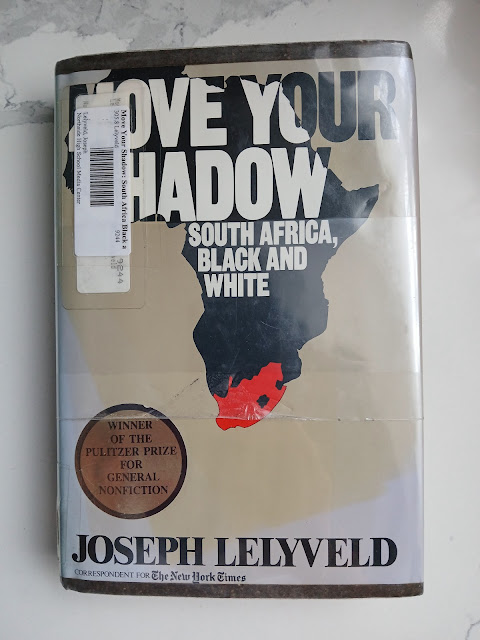
Book Review: Move Your Shadow by Joseph Lelyveld


Since I always had a fascination of South Africa since I first really learned about it as a boy, there was always the desire to learn more about it. Over the years, some sources have been better for that purpose than others. This book, however, was truly a gem in that regard. More than pretty much all of the other journalistic books which I have read about South Africa (during the years of apartheid) over the years, this one really felt like it was written by someone who is intelligent, serious, and trying to portray the country and the situation it found itself in while he was there. There is little to no exaggeration or dramatization, which is not as much the case with another book that I reviewed not too long ago  with Richard Manning's "They Cannot Kill Us All". That was a book which I liked as well. Yet it felt at times like Manning was almost showing off at times (about the house and garden that he had during his stay in South Africa), and being a bit too dramatic at other times.

Yes, Lelyveld takes a serious approach. He writes about South Africa with a relative sense of detachment - repeatedly reminding the reader that he was not from here, and that this was one of many places to which he had been assigned over the years - yet also, perhaps paradoxically, with an approach that betrayed just how much and how seriously he studied the issues. 

Racism has existed in South Africa since the first ship of Dutch settlers came midway in the 17th century. From the early days under Jan Van Riebeeck to the development of Boers (Dutch for "farmers") slowly expanding from the original Cape colony, and eventually to the arrival of the British, which eventually forced the Boers to move into the interior of the continent during their Great Trek, then on through the years of the Boer Republics, to the Boer War and the unification of South Africa as a country, and finally to the 1948 election victory of the National Party (largely representing the Afrikaners, formerly known as the Boers), racism has evolved in South Africa. Strange as it may seem, apartheid in the 1980's - the time during which Lelyveld was in the country - was already far different than it had been in the formative years, or during the 1960's, when Prime Minister Verwoerd laid out a sort of "grand plan" for how apartheid in South Africa was to work. 

Verwoerd is probably the central figure for the first phase of apartheid. In the minds of many Afrikaners, he clarified the racial questions and the solutions which the National Party (NP) set out to resolve these issues. Verwoerd baldly stated racist theories, which were pretty much unquestioningly taken as fact for many white South Africans. He did not believe that blacks needed education, since they were pretty much going to be groomed for lives of menial, low-paying jobs with little to no hope of betterment at any point. Verwoerd also was the one who championed the system of “homelands” to make complete racial segregation a reality. This was a plan to give certain black "homelands" a level of official independence, where they would be recognized as independent nations. Four of them, I believe, actually went ahead with their independence, and as soon as they did, the "citizens" of these newly independent "homelands" lost their status as South African citizens. Indeed, it was a bureaucratic plan to ensure that there would be no black South Africans, at some point. Verwoerd tried to intellectually justify this plan, saying of the blacks that there was “no place for (them) in the European community above the level of certain forms of labor.” As Lelyveld pointed out, the rationale also was to save the blacks in South Africa from the frustration of too much exposure to “the green pastures of European society on which he was no allowed to graze.” 

Lelyveld wrote about the absurdity of the "independent homelands" within South Africa's borders. First of all, they were not large territories of land with definitive boundaries, but rather, they were a bunch of separated chunks of land scattered throughout parts of South Africa. In many parts which the author traveled through, there were not even any signs indicating a border between two countries. Instead, it was just understood that if you were seeing farm fields, you were in South Africa, while if you were traveling through tribal villages & shanty towns, it was understood that this was a “national state.”

South Africa was absolutely determined to make this system of "homelands" work. To that end, they implemented harsh policies, effectively regarding blacks within the country as foreigners belonging to one of these "homelands," and thus justified denying them the benefits of South African citizenship. But there were problems. First of all, there was resistance from blacks themselves. Also, no other country in the world recognized the independence of these "homelands." Also, this was a bureaucratic dream that turned into a nightmare for many people. It proved almost impossible to orchestrate in reality, mostly because the whites had reserved the worst, least productive lands for blacks to inhabit in these "homelands." That meant that most blacks living in homelands had to supposedly cross international boundaries - sometimes several times in the same trip - in order to get to their jobs, which were almost always inside of what was recognized outright as South Africa, before they would have to go back to their "homelands" later that evening. After all, the whole point of the "homelands" system was that blacks who belonged to independent homelands were no longer legally recognized as being South Africans. It was imagined to work by many white South Africa, who wanted to believe. But the reality was that the execution of this plan made things worse, and forced many blacks to try and migrate closer to jobs in cities illegally, thus risking having their homes and communities raided and destroyed on a fairly regular basis by police. There were mass arrests, and bulldozers often present in these seemingly temporary shantytowns. Yet, they were rebuilt almost as quickly as the police would tear them down.

Faith that this dream was working had largely eroded by the 1980's, when Lelyveld was in South Africa for a second time (he had also spent time there in the 1960's, during the Verwoerd era). By that time, South Africa had seen turbulent times in the 1960's, with the Sharpville massacre, and in the late 1970's during the Soweto youth uprisings. There were often violent protests, as well as some bombings, by the 1980's, and there was also increased international scrutiny and pressure for reform. Indeed, Lelyveld suggested that South Africa was quite different in the 1980's than it had been decades earlier during his previous reporting assignment there. he explained that something had "definitely slipped loose, but whatever it was, it wasn’t political power."

The issue was how to proceed with reform. There was recognition and talk of reform by President P.W. Botha in the 1980's. Yet, he tried too hard not to offend anyone, either the world community that demanded reform, or the hardline (mostly Afrikaner) whites within South Africa who were dead set opposed to any kind of reform of apartheid. For all intents and purposes, the whites were divided about reforms, which caused tensions within the country. Yet, even whites who seemed on the surface to want reforms on the surface, Lelyveld points out, really only wanted apartheid itself reformed, not scrapped entirely. Most white South Africans were worried about losing power, and that, to them, was what "one man, one vote" multiracial democracy would effectively translate to. It would mean an end to white power, and they feared (and often rationalized) that handing power to the black majority would inevitably lead to disasters, as it had all across Africa. They pointed to the former Rhodesia (by then already Zimbabwe), among many other examples, and warned that the entire region would be destabilized.

No longer did whites really believe in "apartheid," which had become one of their least favorite words by that point. They had largely abandoned the hardline ideology of old, and they believed the government of Botha when it boasted of the major reforms that took place during his tenure. Officially, segregated buses and trains and bathrooms and such had been scrapped, although everybody knew that in reality, they had only changed the outward appearance, as Lelyveld illustrates in this book. Nothing had really changed, only the hardline language and literal signs. Also, while non-whites were given representation in the government, so that Botha could boast that it was no longer an exclusively white government, the non-whites were not given much power, and lacked any real teeth. Besides, the black majority had still been excluded.

So the struggle had changed shape by the 1980's. Most whites recognized that something was going to happen, that some serious change was inevitable. It felt at the time to many South Africans that the country was a powder keg set to explode. Yet, the white government still somehow managed to hang onto power, and the white population - even those who expressed support for further reforms - seemed unable or unwilling to commit to an actual solution to the myriad problems which apartheid was creating in the nation. In this book, Lelyveld gets us to meet some of the people on all sides. We read about activists, including Winnie Mandela, as well as some prominent players, yet lesser known to people outside of South Africa. He also interviews many whites, with different positions themselves on the situation. Some were all in favor of reform, while others still felt that some version or other of apartheid needed to be kept in place. 

With this book, the reader really gets a solid feel for the paradoxes and difficulties of living under apartheid. One of the things which I remembered best from the first reading of this book was how Lelyveld (and another reporter) went on the buses which transported blacks in one homeland to their jobs in Pretoria, South Africa, which was officially another country, according to the laws which then existed. People would get on the bus in the wee hours in the morning, congregating in the complete dark in what was a makeshift bus stop in what appeared to be the middle of a farm field. The bus would come, and it would quickly grow crowded. Some people would be forced to stand for the hours that they would be on the bus. Many - almost all of the people - would sleep. They would go on these buses to get closer to the city in order to take more buses, where they then would go to work. Then, they would have to board buses heading back, which would require still more hours of travel. So they often would leave incredibly early in the morning and get back late, before getting a few hours of sleep so that they could do it all again the next day. 

That is just one of the examples which I remember best. There are plenty of others in this book. Collectively, they show that the system of apartheid back then just was not working. Yet, the road to reform was tricky and bumpy. Few people really were able to illustrate this quite the way that Lelyveld does in this book, which is why it feels important to say that this book is one of the best ones which I know to read and get a good idea of how apartheid had evolved from the hardline of the 1960's to a white population which knew that something had to change in a meaningful way, yet there was just too much fear to make such meaningful reform a reality at the time.

Of course, we now know, it would come.

Still, this book is great and illuminating to read, if you are interested in the subject of apartheid in South Africa, particularly in the 1980's.

Highly recommended.


Monday, December 30, 2024

Book Review: "Lovely, Dark Deep" by Joyce Carol Oates


Perhaps the strangest thing that I can think to say, after having read this particular book, is that I never really seriously tried to read anything by Joyce Carol Oates before.

Indeed, it seems strange to me now, because the opportunities were there. I picked up a couple of her books in the used sections of bookstores, and once started to read one. But it did not go beyond the first few pages, I think, because the story did not grab me, at least at the time.

Yet, she intrigued me. I had seen her back in 2006, when I attended "An Evening With Our Favorite Writers" in Hartford, Connecticut. She was impressive during that talk. Those were difficult, turbulent and polarized times in this country, politically speaking, much as now. It was difficult not to agree with her well-reasoned positions.

I remember thinking to myself that I should go and pick up some of her books and give her a read. See if her writing would also be something which I could relate to.

Somehow, though, I never did quite get around to it.

At least, not until now.

One thing which I had done was pick up a few copies of some of her books. But I found this particular book last year at some point. It was at a local library, and they were almost giving it away. I think it was going for 50 cents.

Obviously, I went ahead and picked it up.

And I am now quite glad that I did. This proved to be a very good book. Sure enough, I got into it, and her writing style, pretty much right away.

This book is a series of stories, and each of them proves engaging. The title story is about a young woman conducting an interview with iconic New England poet Robert Frost. At first, she feels overwhelmed by the occasion, and Frost seems in his element. However, all of that begins to change as the interview goes along. Admittedly, this short story was kind of a revelation to me, having known relatively little of Frost beforehand. Mostly, I had known his most famous poem, about stopping by the woods before going on. You know the one, about the woods being "lovely, dark, and deep," and then having to go on because there are "miles to go before I sleep." The story was quite fascinating, and made me feel much differently about Frost than I had before.

Yet, that is only one of the stories in this collection. And it comes close to the end, at that. In fact, there is very good variety between these stories. In the first story, "Mastiff," we meet a woman who is no longer strictly young and increasingly feeling the weight of her age. She meets a man quite a few years older than her, and they begin seeing one another, although she still has reservations. Then, something happens while they are hiking together that makes her look at him very differently, to look past her doubts. Only by then, things might have changed, and it may be too late. 

Another story coming relatively early in the book, and which is almost eerily engaging, is “Sex with Camel.” We find a frankly very odd couple, as we learn about just how a 16-year-old boy feels about his grandmother. It grows particularly fascinating as the boy is left to himself after dropping his grandmother in a hospital room, and then wanders the hall to explore the new hospital for himself.

“A Book of Martyrs” is a revealing look at another odd couple - this one an actual romantic couple - who are on a voyage to somewhere we don't quite know, at least to begin with. Yet it becomes clear that the woman is pregnant, although she is not entirely sure she wants to be. Mostly, this is because her lover seems not to want a child, having had his family already. So she is about to get an abortion, and we discover that this is where they are heading. But the whole thing proves even more traumatic than it already would be. She is suspicious and worries about his level of commitment to her, and so she tests this in a couple of ways. We find out the results at the end. This story was quite fascinating, just for taking us into the shoes of a woman who goes to an abortion clinic and then endures the procedure, as well as other things that she had not quite counted on in the process.

"The Hunter" is yet another story with a strange, unorthodox couple. A woman poet falls for a powerful man who holds a powerful position at a college located near a historical landmark associated with the Underground Railroad. In this story, she finds herself constantly drawn - almost against her will, really - to this man, who is the "hunter." Meanwhile, she is going through her own personal issues, with an ailing father whom she has had a difficult relationship with, but whom she feels a need to go visit before he passes. In the end, the strain of the situation between her and these two men proves to be a bit too much. 

"Forked River Roadside Shrine, South Jersey" is from the point of view of a teenaged boy who just recently was killed in an automobile accident. He had been the driver, and the mistake that he made in causing the accident is only one of a number of regrets which he expresses. He watches many people, from family to close friends to teachers at his local school to even some kids whom he does not even recognize, come to his makeshift memorial at the site where he lost control of the vehicle, and ultimately lost his life. Morbid as it may seem, this story particularly drew me in, as it reminded me a bit of my own high school experiences, where it seemed like tragedies in my graduating class (of '92) were astonishingly commonplace.

There are stories that deal with aging, such as "The Disappearing." This story also partially takes place in a hospital, which seems to be a recurring theme in a number of these short stories. An aging woman reflects on her relationship with her husband over the course of many decades. They are both flawed people, yet this is what makes them very human, and thus relatable. He keeps her at arm's length, and she begins to grow suspicious. So at some point, she decides to follow him. Yet, she does so out of an extreme sense of vulnerability that it is impossible not to feel sympathy for, as well as some worries about how much we might be able to relate. As it turns out, the results of her spying, if you will, prove to be mysterious and surprising.

The final story in this collection is likely the longest. It is called "Patricide," and it goes in surprising directions. The main narrator - the daughter of a famous and aging writer - herself expresses surprise at the direction the story takes. She reveals much about her relationship with her famous father, with his actual writings, with how people treat him so reverentially. We see her seemingly guarding her father jealously, almost possessively, towards other people, especially young women taken by the famous author. In fact, we see her go to some surprising lengths to keep one of them, in particular, away. Yet, everything is not quite what it may seem. Her aging father is smaller and frailer than she perhaps recognizes or can bring herself to admit. Nor is she getting any younger. The end of the story brings a complete change in direction, but Oates makes this work. 

Again, this is a solid book. A compilation of short stories, and each of them are enjoyable and engaging. I enjoyed this book quite a bit, enough to look to the works of Joyce Carol Oates for further reading material in the not too distant future, surely.

Highly recommended!


Movie Review: 12 Monkeys


It may seem a bit strange to review a movie that came out more than a quarter of a century ago. In fact, it's been closer to 30 years now since this movie was released.

But this is no ordinary movie.

Of course, let's get one obvious thing out of the way immediately: it is a strange and unconventional movie, to say the least. The title itself suggests as much, as there is no way for anyone not somewhat familiar with this movie, or the television series, to glean any meaning from it or get an idea of what this movie is about just from the title. Then, add some scenes from the movie at random, as I have seen in some of the original trailers, and it probably gets even more confusing. There is a guy who seems dressed up in a space suit, monkeys climbing up a construction site in a modern American city, elephants running through that same city, glimpses of what could be taken as a car chase as well as gun shootouts, and a lot of mysterious talk about viruses and time travel. Again, if you are not familiar with this story, all of this would surely add to the confusion. Even just describing all of that reminds me that, yes, it is a weird movie. 

And to think that even a full viewing of the actual movie might seem to many even stranger still!

Add to that the tagline (although it was ultimately rejected), which reads: "The Future is History."

Now, isn't that intriguing? Just four words, yet in some respects, it kinds of explains the entire movie. Time travel is once again conveyed, yet it also suggests a kind of apocalyptic obliteration of the future, that it no longer exists (or at least, not in any way we would recognize or want it). I still wonder why they rejected this tag line?

This movie has long been one of my favorites, although admittedly, it is not a movie that is too easy to follow (at least not until well, well into the movie). I used to warn people to give it at least twenty or so minutes. If you could bear with it through that much, everything would fall into place, I promise.

After watching it again recently, however, it was obvious that I was wrong, and had underestimated just how long the confusing part specifically meant to disorient the viewer really is. In fact, the first hour or so is specifically designed to make you feel almost disoriented. Here's the thing: this is not a simple movie to "get," but rather, like artwork, it takes a serious and complete examination to fully appreciate it. Because really, it is a work of art, inspired by an artsy old French film, La Jetée. Inspired by that movie, but not a replica or remake. This movie is it's own product, and it is, in many respects, very unique and original. At least as original as a modern move can get in this day and age when no ideas seem to be completely new ideas anymore. 

Believe it or not, this movie has many layers to it. Yes, it addresses numerous issues which remain very relevant to our world today. In fact, I suspect that in many respects, it is more relevant today even than it was back in the mid-nineties, when it was first made and released.

Let me just say, first and foremost, that there is a lot going on in this movie. Thus, it requires some effort, not least of which is patience. I'm not kidding. Indeed, this movie can be both very entertaining and rewarding, even, on many levels. On some levels, it both implements and explores history, mythology, and even popular notions of sanity. And it does this in an interesting and unique way, as it actively tries to make you think about what we understand as sanity versus insanity. It does this right away by deliberately making you wonder exactly what is going on, and to seriously wonder if the main character (James Cole, played very capably by Bruce Willis) is sane or not. After watching it this most recent time, I could see how this movie might bother some people and almost feel possibly like an exercise in lunacy. There are parts of it that are or can be unpleasant to watch, even. Included in this is a sort of repetition in actions and themes, although it is subtle and set under very different circumstances. Yet, it reinforces this notion of this movie and the main character both being and feeling disoriented, not to mention disorienting for the viewer.

I have recommended this movie to some people, and was disappointed in a few cases to hear that they could not get past even the first twenty to thirty minutes. Let us just say is that this is the type of movie that rewards your patience, assuming that you go into it with some and give it a chance. 

The fact of the matter is that this is a purposely strange and unorthodox movie. All kidding aside, it asks more than most movies do, requiring patience and trust on the part of the viewer that the makers of this movie actually know what they are doing, and that things will make sense before all is said and done. I remember feeling confused the first time that I saw it, not knowing exactly what was going on for quite some time.

Trust me, though, it does all come together eventually and, once it does, this movie really becomes rewarding to the viewer. In fact, I liked it so much that it instantly made me want to watch it again, knowing this time what it was about. It became one of my very favorite movies, one which I rarely go more than, say, a couple of years or so without watching. Again, it takes a little patience, although some of the people that I talked to about this movie (I long ago learned not to even bother advocating this movie to most people) never really gave it a chance. Once you actually watch it from beginning to end, there is a good chance that this will be the type of movie that will make you want to see it again and again. I have seen it a number of times over the course of many years now, and it always seems like there is something new, some aspect of it that I had not seen, or at least not had appreciated as much in previous viewings, which I see with the latest viewing.

I have now watched the movie numerous times, and have been on kind of a 12 Monkeys kick lately, since I decided to watch it again a couple of weeks back, and then decided to watch it yet again, feeling that I saw some things with that viewing that I had not paid as close attention to before. So I cannot stress enough at this point that it requires some effort on the part of the movie watcher to actually peel away some of those layers themselves, since the film makers did not want to make it to easy for the viewer. They intentionally made it a movie that requires some thinking.

Frankly, I do not like to overstate things, because that can come back to bite you later. But this movie seems to me to be a masterpiece. It is entertaining, fun and funny at times, yet also serious enough to give you serious pause for thought. Kathryn Railly (played very well by Madeleine Stowe) is everything you could want in a woman, and there are even times when this movie has a nostalgic, old movie feel to it. There are even brief periods when it almost becomes romantic, although it never goes to far or takes itself too seriously in this regard. To me, this has almost everything that you could want in a movie, and comes highly recommended - but again, you have to have some patience with this one. If you do, it will almost assuredly reward you, as this is a movie that you likely will remember and think about for the rest of your life.

Give it a chance, and see what you think.

Also, don't forget to share any thoughts or feelings you may have - positive or negative - here with me. I would welcome any discussion on this movie. 

December 30th: This Day in History


Once again, it should be reiterated, that this does not pretend to be a very extensive history of what happened on this day (nor is it the most original - the links can be found down below). If you know something that I am missing, by all means, shoot me an email or leave a comment, and let me know!


1460 - Wars of the Roses: Battle of Wakefield.

Dec 30, 1853: Southern U.S. border established  James Gadsden, the U.S. minister to Mexico, and General Antonio Lopez de Santa Anna, the president of Mexico, sign the Gadsden Purchase in Mexico City. The treaty settled the dispute over the location of the Mexican border west of El Paso, Texas, and established the final boundaries of the southern United States. For the price of $15 million, later reduced to $10 million, the United States acquired approximately 30,000 square miles of land in what is now southern New Mexico and Arizona.    Jefferson Davis, the U.S. secretary of war under President Franklin Pierce, had sent Gadsden to negotiate with Santa Anna for the land, which was deemed by a group of political and industrial leaders to be a highly strategic location for the construction of the southern transcontinental railroad. In 1861, the "big four" leaders of western railroad construction--Collis P. Huntington, Leland Stanford, Mark Hopkins, and Charles Crocker--established the Southern Pacific branch of the Central Pacific Railroad.   


1897 - Province of Zululand annexed to Natal colony

Dec 30, 1916: Rasputin murdered  Grigory Rasputin, a self-fashioned Russian holy man, is murdered by Russian nobles eager to end his sway over the royal family.  

Dec 30, 1922: USSR established           In post-revolutionary Russia, the Union of Soviet Socialist Republics (USSR) is established, comprising a confederation of Russia, Belorussia, Ukraine, and the Transcaucasian Federation (divided in 1936 into the Georgian, Azerbaijan, and Armenian republics). Also known as the Soviet Union, the new communist state was the successor to the Russian Empire and the first country in the world to be based on Marxist socialism.  


Here's a more detailed look at events that transpired on this date throughout history:

987 - French King Hugo Capet crowns his son Robert the compassionate king
1317 - Pontifical degree "Sancta Romania" against spiritualists
1460 - Wars of the Roses: Battle of Wakefield.
1621 - English king James I cracks Protestation of Parliament
1665 - "Messiah" Sjabtai Tswi departs to Constantinople
1666 - Abraham Crijnssen departs to Suriname
1672 - Baron Karl Rabenhaupt occupies Coevorden Neth
1685 - Don Francisco de Agurto installed as land guardian of S Netherlands
1689 - Henry Purcell & Tates opera "Dido & Aeneas," premieres in Chesea
1703 - Tokyo hit by Earthquake; about 37,000 die
1731 - 1st US music concert (Peter Pelham's great room in Boston)
1794 - French troops conquer Grave Neth
1809 - Wearing masks at balls forbidden in Boston
1813 - Danzig surrenders to allied armies
1816 - The Treaty of St. Louis is proclaimed.
1817 - 1st coffee planted in Hawaii (Kona)
1835 - After gold discovery in Ga, Cherokees forced to move across Miss R
1835 - HMS Beagle/Charles Darwin sails from NZ to Sydney
1836 - Lehman-theater in St Petersburg catches fire; 100s die
1844 - Opera "Stradella" after being rewritten is produced (Hamburg)
1853 - A dinner party is held inside a life-size model of an Iguanodon created by Benjamin Waterhouse Hawkins and Sir Richard Owen in south London.
1854 - Pennsylvania Rock Oil Co, 1st in US, incorporated in NYC
1861 - US, banks stops payments in gold
1869 - Philadelphia Knights of Labor forms
1873 - American Metrological Society forms (NYC) weights, measures & money
1875 - Andrassy Note calls for Christian-Muslim religious freedoms
1877 - Johnannes Brahms' 2nd Symphony in D, premieres in Vienna
1879 - Gilbert & Sullivan's "Pirates of Penzance," premieres
1884 - Anton Bruckner's 7th Symphony in E, premieres in Leipzig
1888 - Belgium: king Leopold II installs Order of African Star
1892 - Dr Miles V Lynk, physician, publishes 1st Black medical journal
1893 - Russia signs military accord with France
1896 - Stanley Cup: Montreal Victorias beat Winnipeg Victorias, 6-5
1896 - José Rizal is executed by firing squad in Manila.
1897 - Province of Zululand annexed to Natal colony
1903 - Electric arc lamp sets fire to Iroquois theater in Chicago leaving 602 dead in one of the deadliest blazes in American history
1903 - American Political Science Association founded at New Orleans
1903 - Fire at Chicago's Iriquois Theater kills 602
1905 - Former Governor Frank Steunenberg is assassinated near his home in Caldwell, Idaho.
1906 - Iran becomes a constitutional monarchy
1906 - The All India Muslim League is founded in Dacca, East Bengal, British India Empire, which later laid down the foundations of Pakistan.
1907 - Abraham Mills' commission declares Abner Doubleday invented baseball
1908 - Stanley Cup: Mont Wanderers outscore Edmonton, 13-10 in 2 game set
1911 - Crickets S F Barnes takes 5-6 in 1st 11 overs v Aust at MCG
1911 - Sun Yat-sen elected 1st pres of Republic of China
1913 - Barnes takes 17 wickets vs South Africa (8-56 & 9-103)
1915 - Cromarty Harbour, Scot-British cruiser Natal explodes: 405 die
1917 - -32°F (-36°C) in Mountain City, Tennessee (state record)
1917 - -37°F (-38°C) in Lewisburg, WV (state record)
1918 - John E Hoover decides to be called J. Edgar Hoover
1919 - Lincoln's Inn in London admits its first female bar student.
1922 - Soviet Union organized as a federation of RSFSR, Ukrainian SSR, Belorussian SSR & Transcaucasian SSR
1924 - Edwin Hubble announces existence of other galactic systems
1925 - NSW score 705 against Victoria, go from 8-475 to 9-701
1926 - Paul Eliot Greens "In Abraham's Bosom," premieres in NYC
1926 - Chicago Tribune reports the Tigers threw a 4-game series to the White Sox in 1917 to help Chicago win the pennant (never substaniated)
1927 - Japan dedicates 1st subway in Orient (route under 2 miles long)
1929 - Cole Porter's musical "Wake Up & Dream," premieres in NYC
1929 - Sigma Gamma Rho Sorority incorporates
1932 - Bradman out for a duck v England at cricket MCG
1933 - -50°F (-46°C) in Bloomfield, Vermont (state record)
1933 - Government disallows NSB-membership for civil service
1933 - Jack Badcock scores 274 v Victoria, Tasmania's 1st double-ton
1935 - Italian bombers destroy Swedish Red Cross unit in Ethiopia
1936 - United Auto Workers stage 1st sit-down strike, at Fisher Body Plant
1938 - Electronic television system patented (V K Zworykin)
1939 - Bradman scores 267 SA v Vic, world record 34th double cricket century
1939 - O'Reilly takes 14-45 (8-23 & 6-22) as NSW crush Qld in 2 days
1940 - California's 1st freeway, (Arroyo Seco Parkway), opens
1941 - Nazibezetters oblige artsen member to become of Artsenkamer
1941 - Nazis require Dutch physicians to join Nazi organization
1941 - Winston Churchill addresses Canadian parliament
1943 - Phillies trade Babe Dahlgren to Pitts for Babe Phelps& amp; cash
1943 - Subhash Chandra Bose raises the flag of Indian independence at Port Blair.
1944 - King George II of Greece, abdicates his throne
1947 - 36th Davis Cup: USA beats Australia in New York (4-1)
1947 - King Michael of Romania, forced by communists abdicates his throne
1947 - Romanian republic proclaimed
1948 - "Kiss Me, Kate" opens at New Century Theater NYC for 1077 performances
1949 - India recognizes People's Republic of China
1950 - Vietnam, Laos & Cambodia become Independent states in France Union
1952 - Tuskegee Inst reports 1952 as 1st yr in 71 with no lynchings in US
1953 - The first ever NTSC color television sets go on sale for about USD at $1,175 each from RCA.
1954 - "House of Flowers" opens at Alvin Theater NYC for 165 performances
1954 - Harold Arlen/Truman Capotes musical premieres in NYC
1956 - NY Giants beat Chicago Bears 47-7 in NFL championship game
1957 - Israeli government of Ben-Gurion, resigns
1957 - New York Giants win NFL championship
1958 - French franc devalued
1959 - George Washington, 1st ballistic missile sub commissioned
1961 - Moscow: premier of Dmitri Sjostakovitch' 4th Symphony (out 1936)
1962 - Green Bay Packers beat NY Giants 16-7 in NFL championship game
1963 - "Let's Make A Deal," debuts on NBC-TV
1963 - Congress authorizes Kennedy half dollar
1963 - Green Bay Packers win NFL championship
1964 - Edward Albee's "Tiny Alice," premieres in NYC
1965 - Ferdinand Marcos inaugurated as president of the Phillipines
1967 - Beatles' "Hello Goodbye," single goes #1& amp; stays #1 for 3 weeks
1967 - Great Western Forum opens in LA
1968 - -48°F (-44°C), Mazama & Winthrop, Washington (state record)
1969 - USSR performs nuclear test at Eastern Kazakh/Semipalitinsk USSR
1971 - Long Island NHL franchise purchased (NY Islanders)
1971 - USSR performs nuclear test at Eastern Kazakh/Semipalitinsk USSR
1972 - Pres Nixon halts bombing of North Vietnam & announces peace talks
1973 - 1st picture of a comet from space (Comet Kohoutek-Skylab)
1973 - Miami Dolphins beat Oakland Raiders 27-10 in AFC championship game
1973 - Minnesota Vikings beat Dallas Cowboys 27-10 in NFC championship game
1974 - Beatles are legally disbanded (4 years after suit was brought)
1975 - "Boccaccio" closes at Edison Theater NYC after 7 performances
1975 - Constitution of Democratic Republic of Madagascar comes into force
1976 - USSR performs nuclear test at Eastern Kazakh/Semipalitinsk USSR
1977 - Carter holds 1st news conference by US pres in Eastern Europe (Warsaw)
1978 - "King & I" closes at Uris Theater NYC after 719 performances
1978 - Ohio State dismisses Woody Hayes as its football coach
1979 - Rock group, Emerson, Lake & Palmer break up
1979 - Togo adopts constitution
1980 - "Wonderful World of Disney," last performance on NBC-TV
1981 - Wayne Gretzky sets NHL record of 50 goals by 39th game of season
1982 - Anthony Shaffers "Whodunnit," premieres in NYC
1982 - England defeat Australia by three runs at cricket MCG
1982 - US Assay Office in New York City, NY closes
1984 - Miss Elizabeth (Hulette) & Macho Man Randy Savage (Poffo) wed
1985 - IBM-PC DOS Version 3.2 released
1985 - Pakistan restores constitution
1987 - Australia hang on for draw v NZ at MCG, 1 wkt left 17 runs short
1987 - Premier Mugabe elected president of Zimbabwe
1988 - Canadian Senate OK's free trade pact; with US
1988 - Former Soviet Pres Brezhnev's son-in-law sentenced to 12-yr (bribery)
1988 - Mercedes-Benz pays $20.2-M fine failed to meet '86 government fuel standard
1988 - North subpoenas Reagan & Bush as defense witnesses for upcoming trial
1989 - 10th United Negro College Fund raises $12,000,000
1989 - Dmitri Volkov swims world record 50m freestyle (27.15 sec)
1990 - "Miser" closes at Circle in Sq Theater NYC after 93 performances
1990 - 11th United Negro College Fund raises $10,000,000
1992 - Last day of Test Cricket for Michael Whitney
1992 - Shane Warne takes 7-52 to lead Australian MCG win v West Indies
1993 - "Candles, Snow, & Mistletoe" closes at Palace NYC after 7 perfs
1993 - Vatican recognizes Israel
1995 - Carquest Bowl 6: North Carolina beats Arkansas, 20-10
1995 - The lowest ever United Kingdom temperature of -27.2°C was recorded at Altnaharra in the Scottish Highlands. This equalled the record set at Braemar, Aberdeenshire on February 11, 1895 and January 10, 1982.
1996 - Proposed budget cuts by Benjamin Netanyahu spark protests from 250,000 workers who shut down services across Israel.
1997 - An abandoned building collapses on NY's 42nd St, no one hurt
1997 - In the worst incident in Algeria's insurgency, the Wilaya of Relizane massacres, 400 people are killed from four villages.
2000 - Rizal Day Bombings: A series of bombs explode in various places in Metro Manila, Philippines within a span of a few hours, killing 22 and injuring about a hundred.
2003 - U.S. Attorney General John Ashcroft recuses himself and his office from the Plame affair.
2004 - A fire in the República Cromagnon nightclub in Buenos Aires, Argentina kills 194.
2005 - Tropical Storm Zeta forms in the open Atlantic Ocean, tying the record for the latest tropical cyclone ever to form in the North Atlantic basin.
2006 - Madrid Barajas International Airport is bombed.
2012 - 19 people are killed by a suicide bomber in Balochistan, Pakistan
2012 - 9 people are killed and 26 are injured in a tour bus crash off interstate 84, Oregon, US
2012 - The opening of Line 6 of the Beijing subway makes it the longest metro network in the world at 442km


1460 - At the Battle of Wakefield, in England's Wars of the Roses, the Duke of York was defeated and killed by the Lancastrians.   1853 - The United States bought about 45,000 square miles of land from Mexico in a deal known as the Gadsden Purchase.   1879 - Gilbert and Sullivan's "The Pirates of Penzance" was first performed, at Paignton, Devon, England.   1880 - The Transvaal was declared a republic. Paul Kruger became its first president.   1887 - A petition to Queen Victoria with over one million names of women appealing for public houses to be closed on Sundays was handed to the home secretary.   1903 - About 600 people died when fire broke out at the Iroquois Theater in Chicago, IL.   1919 - Lincoln's Inn, in London, admitted the first female bar student.   1922 - The Union of Soviet Socialist Republics (USSR) was formed.   1924 - Edwin Hubble announced the existence of other galactic systems.   1927 - The first subway in the Orient was dedicated in Tokyo, Japan.   1935 - Italian bombers destroyed a Sweedish Red Cross unit in Ethiopia.   1936 - The United Auto Workers union staged its first sit-down strike, at the Fisher Body Plant in Flint, MI.   1940 - California's first freeway was officially opened. It was the Arroyo Seco Parkway connecting Los Angeles and Pasadena.   1942 - "Mr. and Mrs. North" debuted on NBC radio.   1944 - King George II of Greece proclaimed a regency to rule his country, virtually renouncing the throne.   1947 - King Michael of Romania abdicated in favor of a Communist Republic. He claimed he was forced from his throne.   1948 - "Kiss Me Kate" opened at the New Century Theatre in New York City. Cole Porter composed the music for the classic play that ran for 1,077 performances.   1953 - The first color TV sets went on sale for about $1,175.   1954 - Pearl Bailey opened on Broadway in the play, "House of Flowers."   1954 - James Arness made his dramatic TV debut in "The Chase". The "Gunsmoke" series didn’t begin for Arness until the fall of 1955.   1961 - Jack Nicklaus lost his first attempt at pro golf to Gary Player in an exhibition match in Miami, FL.   1972 - The United States halted its heavy bombing of North Vietnam.   1976 - The Smothers Brothers, Tom and Dick, played their last show at the Aladdin Hotel in Las Vegas and retired as a team from show business. Both continued as solo artists and they reunited several years later.   1978 - Ohio State University fired Woody Hayes as its football coach, one day after Hayes punched Clemson University player Charlie Bauman during the Gator Bowl. Bauman had intercepted an Ohio pass.   1980 - "The Wonderful World of Disney" was cancelled by NBC after more than 25 years on the TV. It was the longest-running series in prime-time television history.  Disney movies, music and books   1993 - Israel and the Vatican established diplomatic relations.   1996 - A passenger train was bombed by Bodo separatists in India's eastern state of Assam. At least 26 people were killed and dozens were seriously injured.   1996 - About 250,000 striking workers shut down vital services across Israel in protests against budget cuts proposed by Prime Minister Netanyahu.   1997 - More than 400 people were massacred in four villages in the single worst incident during Algeria's insurgency.


1853 The United States bought some 45,000 sq mi of land from Mexico in the Gadsden Purchase. 1911 Sun Yat-sen was elected the first president of the Republic of China. 1922 The Union of the Soviet Socialist Republics was established through the confederation of Russia, Byelorussia, Ukraine, and Transcaucasian Federation. 1940 California's first freeway opened. 1972 President Nixon halted the heavy bombing on North Vietnam. 1993 Israel and the Vatican signed an agreement of mutual recognition to put an end to Jewish-Christian hostilities.

The following links are to web sites that were used to complete this blog entry:

http://www.historyorb.com/today/events.php

http://on-this-day.com/onthisday/thedays/alldays/dec30.htm

http://www.history.com/this-day-in-history

http://www.infoplease.com/dayinhistory